
Chapter 17
Chapter 17 — "The Moratorium on Brains"
TL;DR: With the country paralyzed by Directive 10-289 Dagny resigns in protest and retreats to her cabin in the Berkshires — and in her absence a chain of bureaucratic cowardice forces a coal-burning steam locomotive into the eight-mile Taggart Tunnel pulling the Comet, suffocating every passenger and worker aboard in a black mile of mountain.
Summary: On the morning Directive 10-289 takes effect Dagny walks into Jim's office, hands him a written resignation, and walks out — refusing to run a railroad whose every move is now dictated by Washington. She drives east to her family's old hunting lodge in the Berkshires and disappears from the world. A few days later the Comet, the company's flagship transcontinental express, reaches Winston Station at the eastern mouth of the Taggart Tunnel through the Rocky Mountains; its diesel has failed and no replacement diesel is available. By a chain of telephoned passings of the buck — Mr. Locey, Eddie Willers's terrified replacement; the Unification Board; the regional superintendent; a politically connected senator on board demanding to be on time — a coal-burning steam locomotive is ordered to the Comet. The crew know what this means: an eight-mile, unventilated bore in solid rock will fill with smoke long before the train clears it. They obey because no one will sign the order to refuse. Inside the tunnel, the Comet stops and dies; every passenger and crewman in eighteen cars is asphyxiated. The chapter cuts character vignettes of the dying — a cross-section of the country's complicit citizenry. Word reaches Dagny at her lodge; she comes back to NYC the same night and resumes her job.
Key scenes:
- Dagny resigning — calm, written, no scene; Jim staring at the page, terrified
- The Berkshire lodge in early-summer green light — silent, isolated, hummingbirds in pine
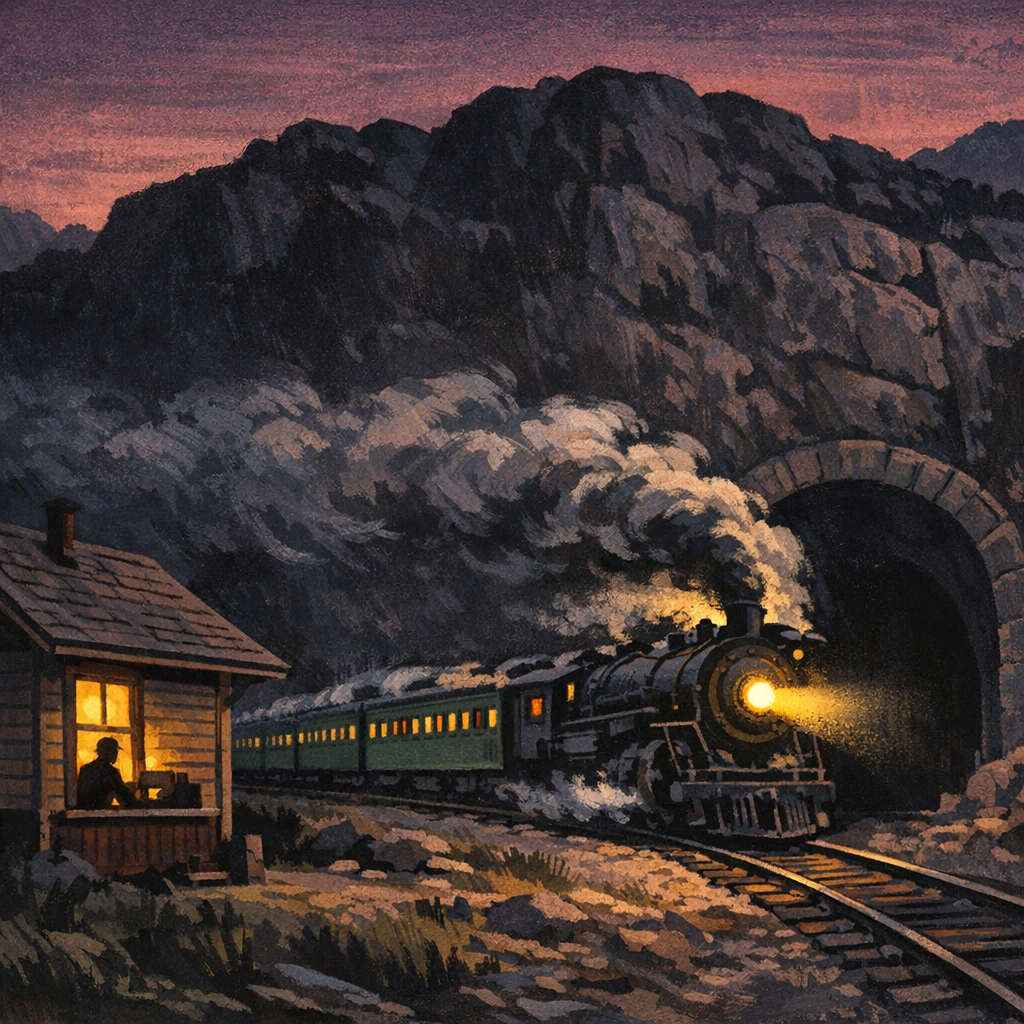
- Winston Station outside the Taggart Tunnel — a railroader's small clapboard depot in a high mountain meadow, the black mouth of the tunnel ahead
- A montage of telephone calls — bureaucrats refusing responsibility, each pushing the order one rung down
- The Comet entering the tunnel — yellow headlamp swallowed by black, smoke coiling back along the cars
- Vignettes inside the cars — sleeping children, a businessman reading, a philosophy professor, a politician, each rendered in one camera-flash sentence as the smoke fills the air
- Dagny back in her Taggart office at dawn after the catastrophe, lifting the receiver
Characters present: Dagny Taggart, James Taggart, Eddie Willers, Mr. Locey (Eddie's replacement), Mr. Kinnan (Unification Board), an unnamed senator, the Comet's engineer and conductor, a panel of unnamed passenger vignettes
Locations / settings:
- Taggart Transcontinental headquarters — empty offices, panicked night staff
- The Berkshires lodge — pine, sun, silence
- Winston Station, Colorado Rockies — clapboard station, mountain meadow, the tunnel mouth in dark stone
- The Taggart Tunnel — eight miles of unventilated stone bore, headlights swallowed, then black
- Inside the Comet's coaches — gas-light reading lamps, sleeping figures, smoke rising from floor vents
Visual motifs: a coal-burning steam locomotive wheezing into a black tunnel mouth, smoke coiling back along its cars; a series of telephone receivers passed up and down a chain of dim offices; portrait flash-vignettes of the doomed; a small lit lodge in pine forest while a country dies west of it
Emotional tone: apocalyptic, methodical, savagely indictful, then exhausted
Confidence: high — the Tunnel disaster is one of the most-discussed set pieces in the novel.