
Chapter 26
Chapter 26 — "(untitled)"
TL;DR: In Camelot (Jimmy’s reinvented London), Martin and Phillip confront Jimmy, who calmly lays out his “benevolent ruler” rationale while flaunting total control of the code.
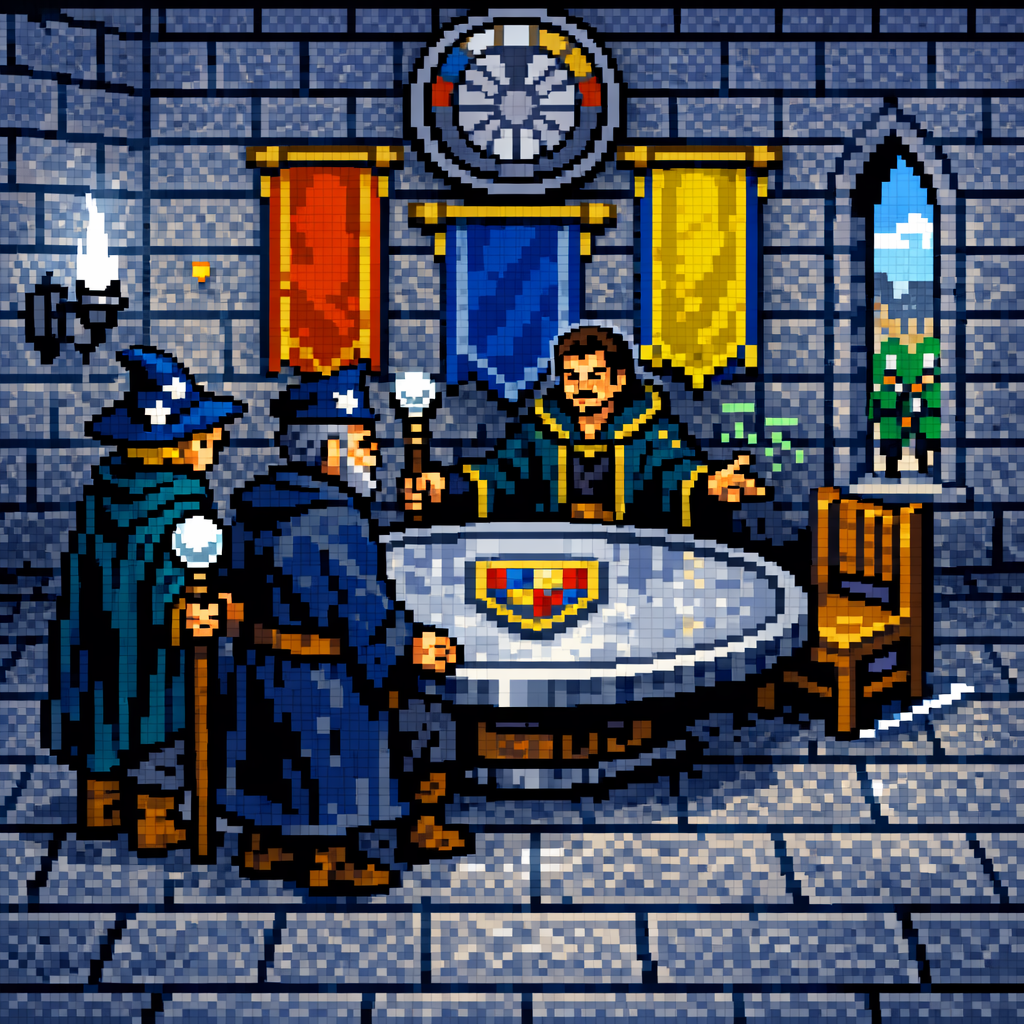
Summary: Martin and Phillip are brought before Jimmy in the heart of his Camelot, a medieval hall dressed up to match the legend: stone flags underfoot, a round table silhouette upstage, banners in primary colors, and a carefully curated view of timbered streets through tall arrow-slit windows. Jimmy, every inch the showman “Merlin,” uses casual edits to reality—chairs slide into place, doors lock with invisible latches, torches brighten without smoke—to underscore his argument that wizards should improve the age rather than hide. He explains himself without shouting: order over chaos, sanitation and safety over superstition and squalor, the myth of Arthur made manifest to give people a story strong enough to follow. He folds in a coder’s logic about the Repository: no fragile timeline to break, just parameters to set, so the ethical question becomes how much suffering you’re willing to tolerate by not intervening. Martin clocks the arrogance behind the polish—the way Jimmy’s eyes keep flicking to his device, the way the room itself seems timed to applause—and realizes Jimmy isn’t just managing a city, he’s A/B testing a legend. The scene ends not with spells thrown but with a line in the sand: back off or be treated as saboteurs, delivered with a smile and a subtle demonstration that he can relocate or immobilize them with a keystroke.
Key scenes:
- Great hall of “Camelot” (London): Jimmy receives Martin and Phillip at a round table under bright heraldic banners; he manipulates seating and lighting with invisible edits as he starts his speech.
- Arrow-slit overlook: A window-framed vista of clean, busy streets and makeshift “knights” on patrol serves as Jimmy’s visual proof that his system works.
- Code-as-theater demo: Jimmy freezes a drifting cinder midair and slides furniture on a grid, the world briefly stuttering like a paused sprite—his friendly threat disguised as stagecraft.
- Corridor exit: Guards in mix-and-match mail and leather flank a corridor of gray stone; a heavy door seals behind Martin and Phillip with no visible bar, reminding them who owns the room.
Characters present: Martin, Phillip, Jimmy
Locations / settings:
- Camelot great hall (London): broad stone floor, round table silhouette, primary-color banners, torch brackets that glow too evenly to be fire
- Arrow-slit window with city view: half-timber facades, straightened cobbles, pennants over a gate, Thames light as a flat blue strip
- Stone corridor outside the hall: narrow, drafty, with repeating sconces and a door that shuts itself on a perfect grid snap
Visual motifs: saturated sky-blue sliver in windows, forest-green and crimson banners, charcoal stone blocks, glowing white highlights that read as “edits,” brown staff wood and benches, terminal-green glyphs ghosting over parchment maps, pixel-grid orderliness (objects align to neat tile boundaries), round-table silhouette as a flat emblem, cleaned cobbles in sandy-ochre against darker alleys, guards’ mail rendered as chunky steel-gray dither, subtle “pause” shimmer when Jimmy flexes control
Emotional tone: smugly cordial, unsettlingly controlled, witty
Confidence: low — I don’t have chapter-by-chapter recall; details inferred from the book’s known confrontation with Jimmy and the provided seed summary.