
Chapter 4
Chapter 4 — "Astrophage"
TL;DR: In a flashback to a high-security lab, Grace identifies the Petrova-Line dust as a single-celled alien organism that eats stars — and names it Astrophage.
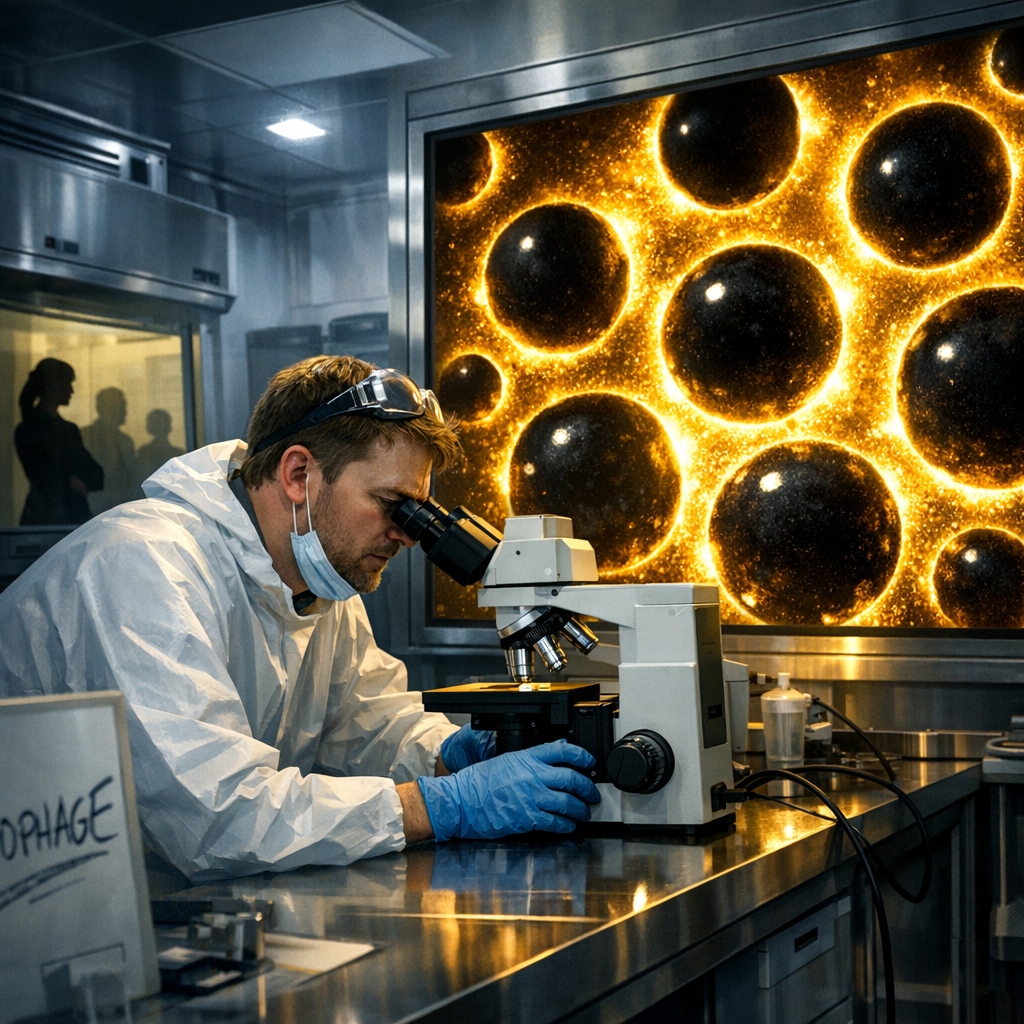
Summary: Grace remembers being walked into a hardened lab, gowned and gloved, alone with the sample. Under the microscope the dark grains resolve into individual cells — far hotter than they should be, perfect black-body radiators at 96.415°C, the exact temperature of Venus's lower atmosphere. He proves that the cells store enormous amounts of energy and re-emit it as infrared. He demonstrates, by accident, that they can move under their own power and follow heat gradients. He realizes they are alive, alien, and capable of feats no Earth biology can match. He names them Astrophage — "star eaters." Stratt, watching through observation glass, immediately understands the implication: this is what is darkening the sun.
Key scenes:
- Grace alone at a microscope station in a sterile clean-room lab, dark sample on the slide
- The cells captured under the lens — perfectly round, jet-black, individually radiating heat
- Stratt and a small team of scientists watching through observation glass, reactions sharpening as Grace narrates findings
- Grace writing "ASTROPHAGE" on a whiteboard
Characters present: Ryland Grace, Eva Stratt, unnamed observation-room scientists/officials (Lokken, Leclerc, others not yet named on-screen)
Locations / settings:
- A high-security biocontainment lab — stainless surfaces, fume hoods, glove boxes, an observation window facing a dim conference room
- A whiteboard with the new word freshly written in bold marker
Visual motifs: a single black grain glowing infrared on a glass slide, the gold of the cover repurposed as the Astrophage's stored solar energy bleeding out, harsh overhead lab lighting, gowned figures behind glass, a whiteboard with one word that changes the world
Emotional tone: awed, grimly focused, scientifically electric
Confidence: high — the Astrophage discovery sequence is detailed identically across every summary source.