
Chapter 6— Bob in the Skull
Bob in the Skull
TL;DR: Down in the subbasement lab, Harry walks Bob — the air spirit in the rune-carved human skull on his workbench — through the murder, and together they work out the killer's recipe: storm energy plus an intimate link plus a willing pair of practitioners channeling through them.
Spoilers through Chapter 6.
In one sentence
The book's first long lab scene and the chapter where the murder's mechanism gets named with enough precision that Harry can start hunting backwards from the spell.
What happens
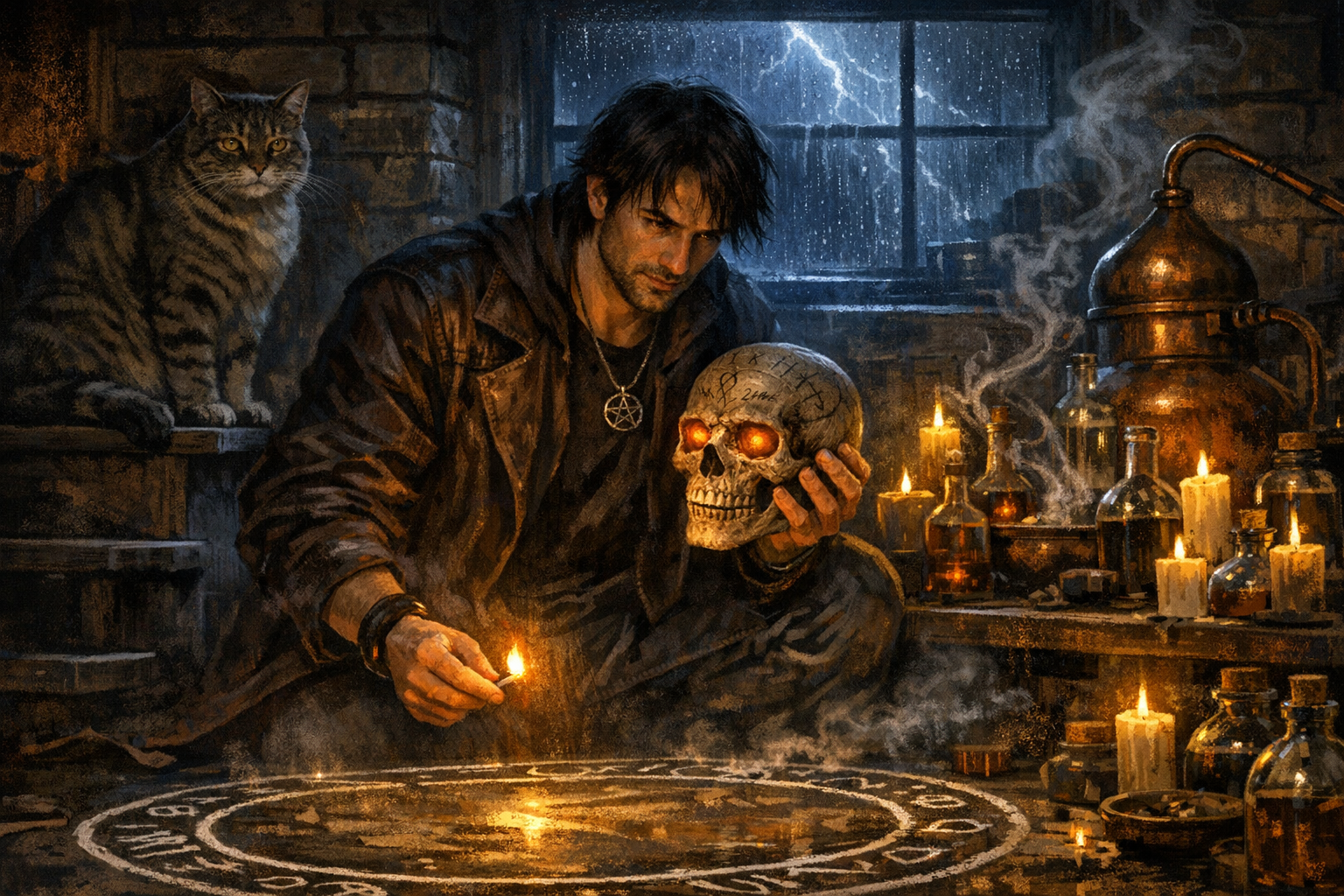
Harry goes home, feeds Mister, and descends two flights into the subbasement to the chalked workbench where the candles are already half-burned. Bob wakes up — ember-orange eye-fires kindling in the empty sockets — and is told the case. Bob is delighted, in the way only a centuries-old air spirit can be delighted, about the technical challenge. He walks Harry through the recipe: a working of this caliber needs sympathetic links to the victims (intimacy provides them); a power source (storms are batteries); a pair of willing practitioners feeding the channel through sex magic (the willing pair are the operators, not the victims). The killer is not in the room with the victims. The killer is somewhere else, drawing on a storm, riding a circuit through people who consented to be the conduit.
Bob also wants something in exchange — Harry agrees to get him a new romance novel. The chapter ends with Harry knowing exactly what he is looking for and lacking only the names to put on the model.
Key moments
- Bob's introduction. The skull, the eye-fires, the voice, the smut. Butcher establishes the comic engine of the series in twenty pages.
- The recipe. The killer's method, fully described, with no theatrics. The book treats magic as engineering and the chapter respects the engineering.
- The price. A romance novel. The chapter is funny about the bargain and serious about the bargain at the same time.
- Mister upstairs. A small grounding beat between the workbench and the rest of the day.
Character shifts
Harry is at his most relaxed in this chapter — he is in his own basement with the only colleague who does not want him dead. The voice loosens. Bob, who will be a presence across the entire series, lands fully formed.
Why it matters
Once you know the recipe, you know what the killer needs. The rest of the book is Harry tracing the ingredients — the sympathetic links, the storm timing, the operators — until they point at one address.
Themes to notice
- Magic as engineering. The book wants you to feel that this is not arbitrary; rules apply and the rules can be learned.
- The economy of working for free vs. working for pay. Bob trades in romance novels. Toot will trade in pizza. The series will keep returning to faerie-style barter logic.
For your book club
- Bob enjoys the puzzle and trusts Harry with the ethics. Is that a comfortable division of labor, or is the book asking you to be slightly worried about it?
- The recipe involves consent — willing practitioners, intimate connection. The murder works because the operators want to do it. What is Butcher arguing about magic's relationship to consent?
- Track Bob's voice in this chapter. How does Butcher signal that the skull is a person without ever describing facial expressions?
Visual memory hook
A candlelit basement workbench: a rune-carved ivory skull with ember-orange eye-fires kindling in the sockets, a copper alembic, mason-jar potions on masking-tape labels, dog-eared paperbacks stacked beside the skull as payment, chalked summoning lines scuffed across the wooden top, and a tall wizard with rolled sleeves leaning on the bench like a man who is finally somewhere safe.
Next chapter, no spoilers
A black limousine is parked at the curb when Harry comes back upstairs.