three-mental-processes
The Three Mental Processes
Concept-character. Rendered as an editorial infographic, not a figure portrait, per the non-fiction adaptation. This is the master diagram of the book — the framework character.
Name
- Canonical: The Three Mental Processes / The Three Circles
- Aliases: The Mental Management System (the framework as a whole), CM/SC/SI, the Three-Circles Diagram, the Balance of Power model
Role in the system
The book's structural backbone. Every performance — every shot, putt, presentation, sales call — flows through these three mental processes simultaneously. The Three Mental Processes character represents the whole framework viewed at once, not any single circle. Sections 2, 3, and 4 of the book are each devoted to building one of the three; Chapter 4 (Balance of Power) is devoted to keeping them in balance.
Personality / energy ("functional behavior")
- Holistic: the framework is all three together. Any single circle considered alone is incomplete.
- Balance-seeking: optimal performance is when all three rings are equally large and equally trained — Bassham's "Balance of Power" principle.
- Imbalance-diagnostic: when performance breaks down, the framework's job is to tell you which circle is the bottleneck (knowledge ahead of skill? skill ahead of self-image? etc.).
- Growth-capable: the rings can grow — the goal of training is to grow them all together.
Physical description ("visual representation")
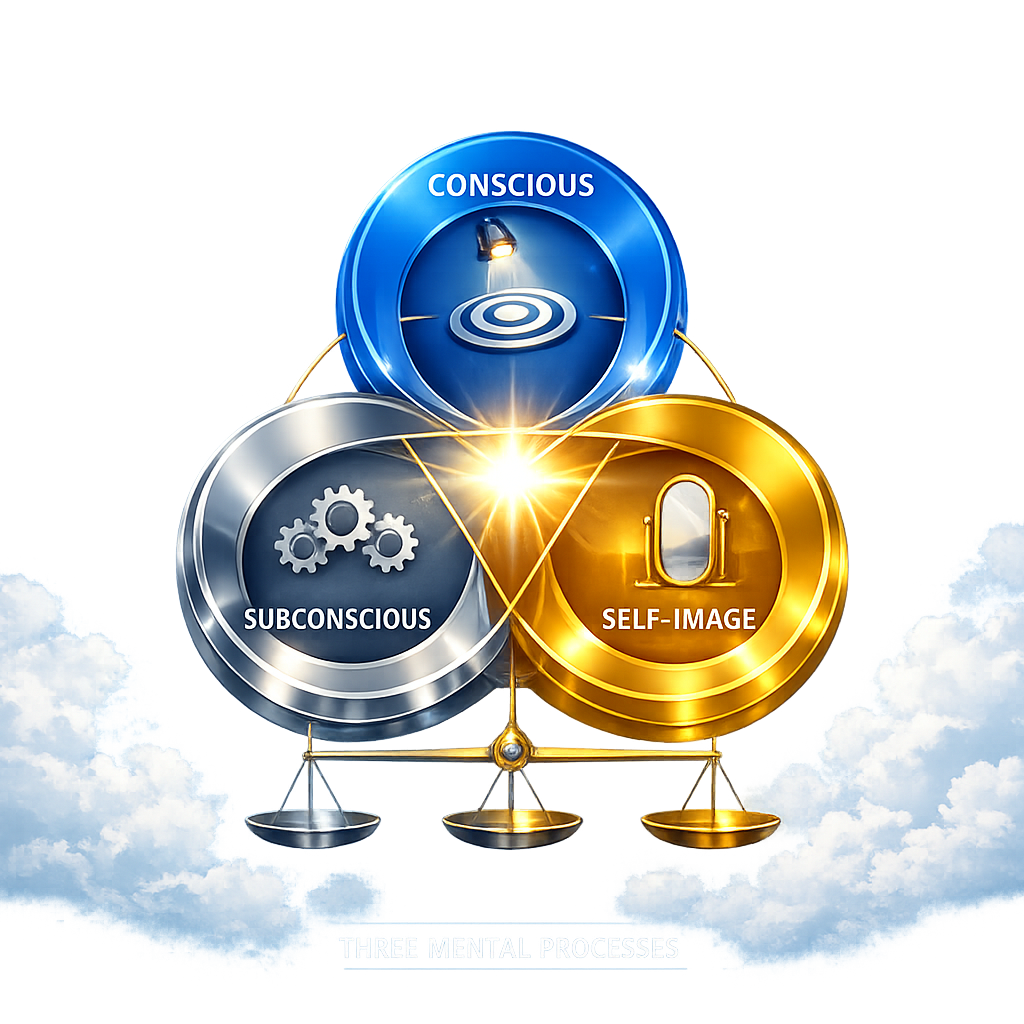
Three rings — cerulean (Conscious), chrome (Subconscious), burnished gold (Self-Image) — arranged in a balanced composition. The canonical layout: a slight overlap/Venn arrangement where the three circles meet at a central point, their colors blending at the intersection into a clean white-gold light. Each ring carries the visual signature established in its own concept guide (spotlight beam in CM, gears in SC, mirror in SI), miniaturized so all three fit in one frame. The whole composition reads as the book's master diagram — the image you'd see on the inside cover of a textbook.
Outfit / clothing notes ("secondary visual elements")
- Three thin connecting filaments arc between the three rings' centers, forming an equilateral triangle of relationships — labeled at each apex (CONSCIOUS / SUBCONSCIOUS / SELF-IMAGE).
- A subtle scale-balance motif beneath the composition — three plates suspended at equal height, communicating "Balance of Power."
- Lower edge: small label "THE THREE MENTAL PROCESSES" in clean white sans-serif.
Visual motifs
- Three colored rings (blue + chrome + gold) in a triangular / Venn arrangement.
- Equilateral triangle of connecting filaments (the relationships).
- Scale-balance motif (the Balance of Power).
- Central white-gold blend point where all three meet — the "in-balance" zone.
Magic / power signature ("signature mechanic")
Balanced growth. Visualized in two states in any chapter image that uses this character: balanced (all three rings equal size, plates level, central blend bright) or imbalanced (one ring bloated, plates tilted, central blend dim).
Chapter appearances
- Ch 3 — Principles of Mental Management (the framework's full introduction)
- Ch 4 — The Balance of Power (the framework's diagnostic mode — equal vs. imbalanced)
- Ch 5–18 — referenced as backdrop / structural reference throughout
- Ch 19 — The Challenge (the framework recapped as the toolkit being handed to the reader)
Source references
- https://www.lucasballasy.com/posts/blt-no-134-7-mental-management-principles-from-with-winning-in-mind-by-lanny-bassham (the seven principles built on the three-process model)
- https://www.robrashell.com/thelibrary/books/withwinninginmind/ (three mental processes overview)
- https://www.scribd.com/document/364432776/Lanny-Bassham-With-Winning-in-Mind-3rd-Ed-Booksee-org (Balance of Power)
Confidence
High — the three-circles model is Bassham's signature framework, repeatedly diagrammed in his materials.