three-phases-of-a-task
The Three Phases of a Task
Concept-character. Rendered as an editorial infographic, not a figure portrait, per the non-fiction adaptation.
Name
- Canonical: The Three Phases of a Task
- Aliases: Anticipation / Action / Reinforcement, the three-phase chassis, the time-strip
Role in the system
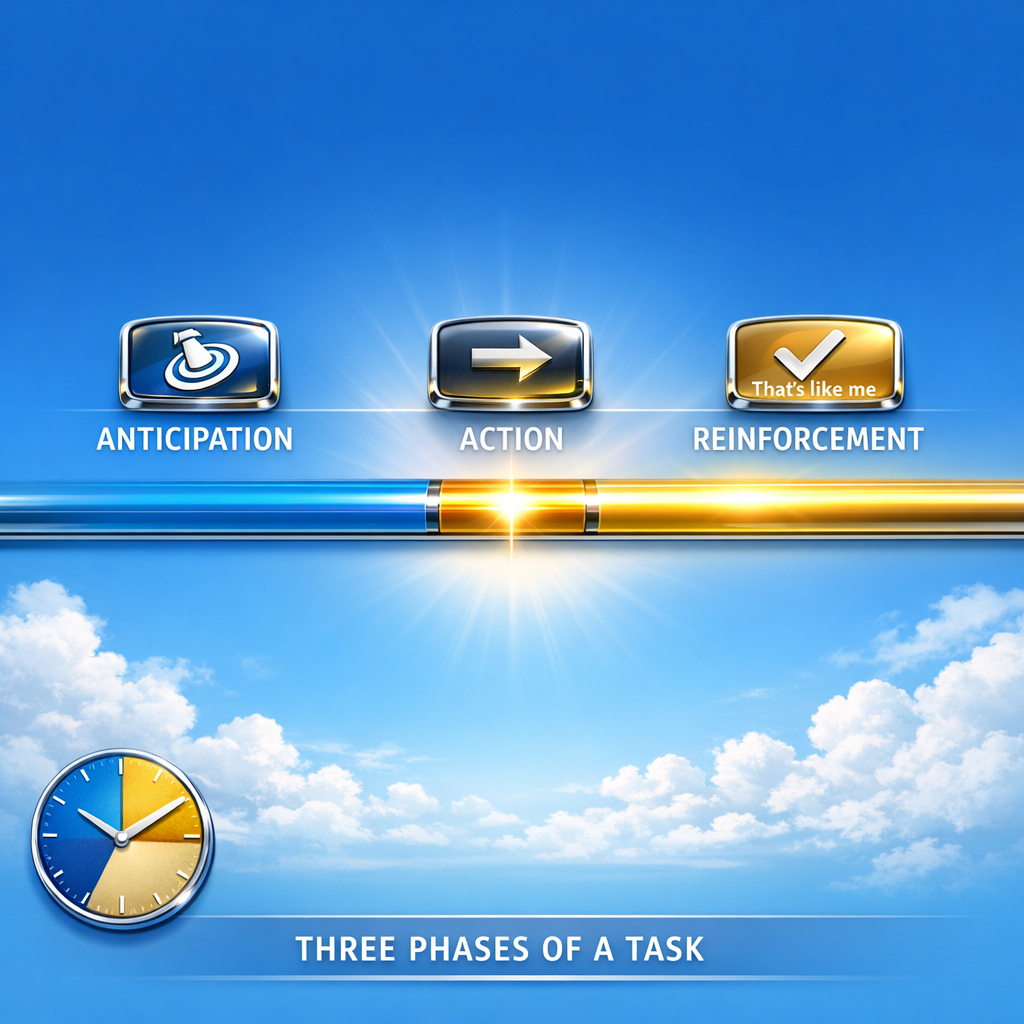
The Three Phases of a Task are the temporal chassis on which the Mental Program runs. Every executed task — a free-throw, a shot, a sales call, a stage performance — has three phases: Anticipation (everything before the action: setup, breath, mental rehearsal, decisiveness commit), Action (the brief instant of execution itself, run by the Subconscious), and Reinforcement (everything immediately after: success-coding, "That's like me," journaling). Bassham's claim is that champions do work in all three phases; amateurs only work in Action and either skip Anticipation (no Program) or skip Reinforcement (no learning loop). The Mental Program is essentially a Program filling the three phases with prescribed content.
Personality / energy ("functional behavior")
- Linear and ordered — Anticipation always precedes Action precedes Reinforcement.
- Asymmetric in time — Anticipation is long (seconds to minutes), Action is brief (milliseconds to seconds), Reinforcement is medium (seconds).
- Each phase has its own dominant Process: Anticipation uses the Conscious Circle (planning), Action surrenders to the Subconscious Circle (execution), Reinforcement updates the Self-Image Circle (identity).
- Loop-ready — the end of one Reinforcement feeds the next Anticipation.
Physical description ("visual representation")
A horizontal three-segment time-strip rendered in hyperreal CGI as a premium chrome track running across the middle of the frame. The track carries three colored phase-bands: left segment (~40% width) is cerulean tinted (Anticipation), middle segment (~10% width) is saturated gold (Action — visually compressed to communicate the brevity of execution), right segment (~30% width) is light/burnished gold (Reinforcement). Above each band sits a small premium chip carrying that phase's icon: Anticipation = the Conscious-Circle spotlight glyph, Action = a single clean directional arrow, Reinforcement = a checkmark + small "That's like me" label. A subtle clock-dial motif sits at the lower-left of the frame, with three sweeping pie-slices in the same band colors — communicating that this is a time infographic.
Outfit / clothing notes ("secondary visual elements")
- Horizontal chrome track with three colored phase-bands (cerulean / gold / light-gold).
- Three small chips above the bands carrying phase-glyphs.
- Clock-dial motif at lower-left with matching pie-slice band colors.
- Small white sans-serif label "THREE PHASES OF A TASK" along the bottom edge.
- Phase labels above the chips: "ANTICIPATION / ACTION / REINFORCEMENT" — small white sans-serif.
Visual motifs
- Three-band horizontal time-strip — the chassis the Mental Program runs on.
- Asymmetric band widths showing the brevity of Action — visual statement of the system's claim.
- Cerulean + gold + light-gold palette — palette continuity with the Three Mental Processes (each phase is "owned" by a Process).
- Clock-dial pie motif anchoring the time-axis interpretation.
Magic / power signature ("signature mechanic")
Phase-segmentation of every task. Render the Anticipation band with a faint forward-pulse animation cue (one direction), the Action band with a sharp spike-of-light at its center (the moment), and the Reinforcement band with a soft warm afterglow — communicating the three different temporal qualities of each phase.
Chapter appearances
- Ch 8 — Three Phases of a Task (full chapter — feature appearance)
- Ch 9 — Running a Mental Program (the Program fills these phases)
- Ch 13 — The Performance Journal (Reinforcement phase tool)
- Ch 16 — How to Run a Mental Program (operational walkthrough across phases)
- Ch 19 — The Challenge (recapped as the chassis to internalize)
Source references
- https://www.robrashell.com/thelibrary/books/withwinninginmind/ (Three Phases as the temporal frame)
- https://www.lucasballasy.com/posts/blt-no-134-7-mental-management-principles-from-with-winning-in-mind-by-lanny-bassham (Anticipation/Action/Reinforcement labeled)
- https://whatgotyouthere.com/with-winning-in-mind-by-lanny-r-bassham/ (phase ownership: Conscious / Subconscious / Self-Image)
Confidence
High — Three Phases is one of Bassham's most-quoted constructs with consistent labeling.