
Chapter 3— Natural History: Bemushroomed
Natural History: Bemushroomed
TL;DR: Psilocybin mushrooms have a stranger history — and a stranger present — than most readers expect, and Pollan's first experience with them teaches him something foundational: perception is not recording, it's projection.
Spoilers through Chapter 3 (Chapter Two).
Chapter in one sentence
Pollan traces the natural history of psilocybin mushrooms — from fungal ecology to the Western discovery ceremony to his own first experience — and arrives at a revision of how he understands perception itself.
What happens
The chapter has three movements. First, natural history: Pollan profiles Washington mycologist Paul Stamets, whose 1996 field guide Psilocybin Mushrooms of the World mapped the landscape for a generation, and examines the question of why mushrooms evolved psilocybin at all. The leading hypothesis: as a signal to animal nervous systems that consumed the mushrooms, encouraging further consumption and spore dispersal. Psilocybin, in this framing, is the fungal kingdom's opening bid in a chemical conversation with animal brains — a conversation humans have been having, largely unconsciously, for millennia.
Second, Western discovery: Pollan traces the story of R. Gordon Wasson's 1955 ceremony in Oaxaca with Mazatec curandera María Sabina — the moment that brought psilocybin to Western attention, and the publication of Wasson's account in Life magazine in 1957, which landed on millions of American doorsteps and changed everything. He also examines Terence McKenna's speculative "Stoned Ape Theory" — the idea that psilocybin catalyzed human self-reflection and language development — with appropriate skepticism but genuine engagement.
Third, personal: Pollan describes his own first mushroom experience, guided informally in a backyard garden. The insight that lands hardest is not visual but epistemological: perception is not passive observation. He is not receiving impressions from the world — he is projecting emotion onto it. The garden isn't beautiful; he is making it beautiful. Emerson's "Nature always wears the colors of the spirit" stops being a metaphor and becomes a description.
Key moments
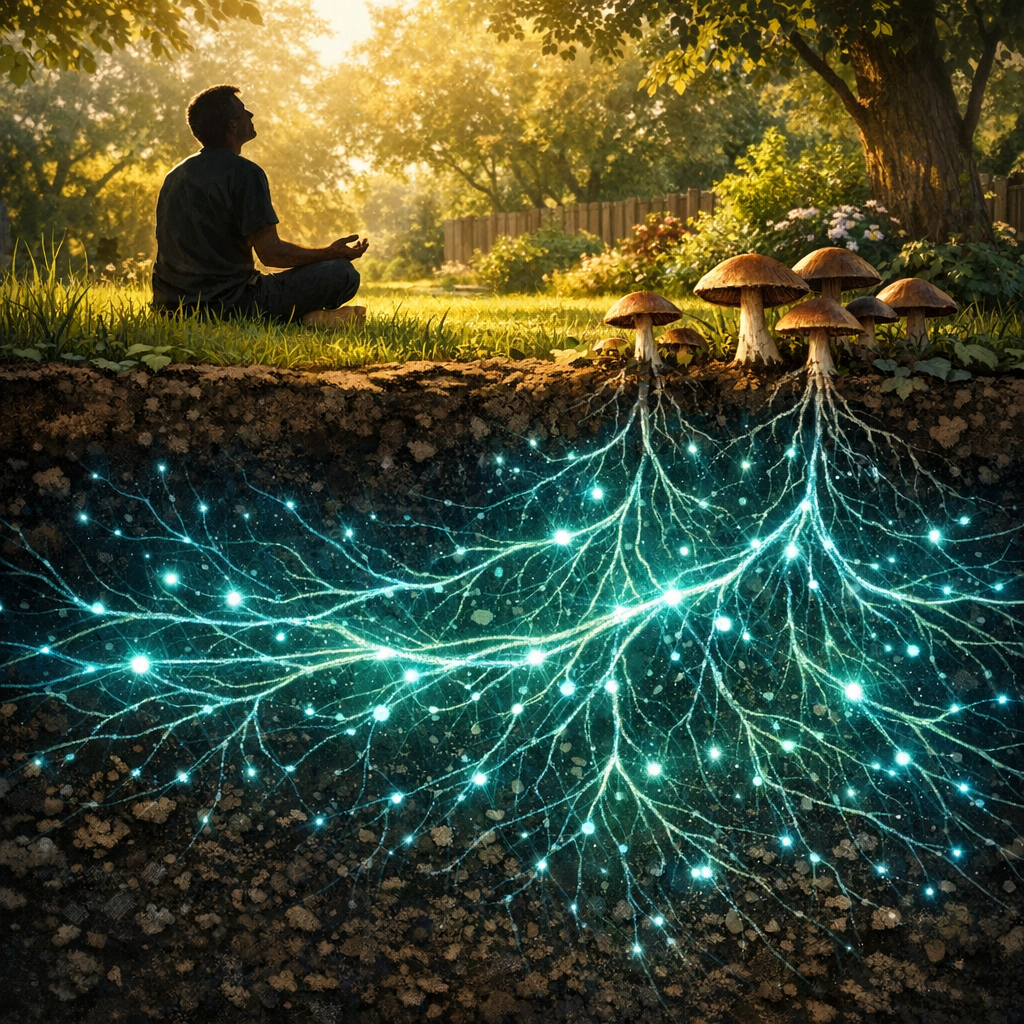
Stamets on mycelium — The mycologist describes the fungal underworld as a kind of internet running beneath every forest floor. Psilocybin mushrooms are one signal in a vast network humans have been ignoring.
Wasson's ceremony, 1955 — A New York banker travels to a Mazatec village and participates in a nighttime ceremony with María Sabina, drinking mushroom tea and lying on the floor of a candlelit hut. He is the first Western outsider to formally document the experience.
The Life article — Wasson writes about the experience for Life magazine in 1957, reaching a mass American audience. The title: "Seeking the Magic Mushroom." Timothy Leary reads it. So does virtually everyone else.
Pollan in the garden — Under mushrooms in a domestic suburban garden, Pollan watches objects acquire emotional weight. The garden isn't showing him itself; he is showing himself to the garden.
Why it matters
The chapter grounds the book's science in something older: the human relationship with psilocybin-containing fungi predates modern science by centuries. The ceremony Wasson attended was not a counterculture experiment — it was an ancient technology. Understanding this matters because it changes the frame: we are not inventing a new treatment. We are rediscovering a very old one.
Themes to notice
- The above and below — The mycelial network beneath the soil mirrors the neural network within the skull. The book draws this comparison subtly throughout.
- Perception as participation — Pollan's first-experience insight — that he is projecting rather than receiving — is the philosophical seed of everything in Chapter 5.
Book club questions
- Psilocybin may have evolved in mushrooms as a signal to animal nervous systems — effectively a chemical negotiation. Does knowing the "evolutionary purpose" of a substance change how you think about its effects?
- The Mazatec ceremony Wasson attended had been practiced for generations before Western contact. What is gained and lost when an indigenous technology enters Western medicine?
- Pollan's backyard experience teaches him that perception is projection. Have you ever had an experience — drug-induced or not — that made you question whether you were observing the world or creating it?
Visual memory hook
A cross-section of forest floor: ordinary garden above, bioluminescent mycelial network glowing beneath. Two worlds in one frame, separated by inches of soil.