
Chapter 6— The Neuroscience: Your Brain on Psychedelics
The Neuroscience: Your Brain on Psychedelics
TL;DR: Psilocybin doesn't activate the brain — it quiets the part that generates the ego — and this one counterintuitive finding unlocks a theory of consciousness, mental illness, and healing that the book spends the rest of its time applying.
Spoilers through Chapter 6 (Chapter Five).
Chapter in one sentence
Pollan surveys the neuroscience of psychedelics, centered on Robin Carhart-Harris's fMRI research and the Entropic Brain Theory, which proposes that the brain's most stubborn disorders are problems of too much order — and that psilocybin treats them by temporarily dissolving it.
What happens
The chapter begins with the question nobody had answered rigorously before Robin Carhart-Harris: what actually happens in the brain during a psychedelic experience? The expected answer was that psilocybin activates the whole brain — more activity, more connections, more of everything. The actual answer, when Carhart-Harris put people in fMRI scanners, was the opposite: psilocybin decreases activity, specifically in the Default Mode Network — the hub that coordinates self-referential thinking, rumination, and the maintenance of the self-narrative.
The deeper the DMN suppression, the deeper the ego dissolution and the higher the Mystical Experience Questionnaire score. The neurological and phenomenological data aligned perfectly: the experience of the self going quiet is, physically, the DMN going quiet.
Pollan then works through the implications. The Entropic Brain Theory (Carhart-Harris) proposes that brain states exist on a continuum from excessive order (depression, OCD, addiction — the DMN locked in rigid self-reinforcing loops) to excessive entropy (psychosis, mania). The therapeutic sweet spot is introducing controlled entropy to a brain that has become too ordered. The "controlled hallucination" thesis follows: normal waking consciousness is itself a predictive construction, a managed filter — not direct access to reality, but a model of reality optimized for survival. Psychedelics briefly lift the filter.
Alison Gopnik's developmental psychology adds a third frame: infants have immature DMNs and experience "lantern consciousness" — diffuse, high-entropy, wide-open awareness, unfiltered and creative. Adults develop "spotlight consciousness" as the DMN matures — efficient, focused, but narrow. Psychedelics temporarily restore the infant state.
Key moments
The counterintuitive finding — Carhart-Harris watching the first fMRI scans of a psilocybin brain: "I was amazed — everything went down, not up."
The seesaw model — The DMN and attentional networks as opposing weights. The DMN dominates in depression, rumination, and the anxious default state. Psychedelics shift the seesaw.
Alison Gopnik on infants — "Babies are basically tripping all the time." They haven't built the filter yet. Adult cognition is what you lose when you build the filter.
Judson Brewer's meditator studies — Experienced meditators show the same DMN deactivation patterns as psilocybin subjects. Two paths to the same neurological destination.
The Entropic Brain dial — From coma (zero entropy) to psychosis (too much entropy), with a therapeutic zone in the middle. Depression, OCD, and addiction are all left of center. Psychedelics move the dial right — toward the zone.
Why it matters
Chapter 5 is the key that unlocks everything else in the book. Without the neuroscience, the clinical results in Chapter 6 are remarkable but unexplained. With it, they make sense: psilocybin treats depression by temporarily dissolving the DMN loops that generate it. It treats addiction by providing a perspective from which the habit story becomes visible and optional. It treats death anxiety by temporarily removing the ego that was doing the fearing.
Themes to notice
- The brain as prediction machine — If normal consciousness is a "controlled hallucination," what does that say about the status of ordinary experience? The book asks this question without fully answering it, which is exactly right.
- Order and entropy — The chapter reframes the entire "your brain on drugs" narrative. Psychedelics don't create chaos in an orderly brain — they dissolve excessive order in a brain that has become too rigid.
Book club questions
- The finding that psilocybin suppresses the brain was the opposite of what researchers expected. What do you make of the fact that one of the most expansive human experiences is neurologically characterized by quieting down?
- Carhart-Harris proposes that depression is partly a disorder of excessive mental order — the DMN locked in rigid loops. Does this change how you think about what depression actually is?
- Alison Gopnik says children experience "lantern consciousness" that we lose as adults. Is the loss of that diffuse awareness a tragedy or a necessary development?
Visual memory hook
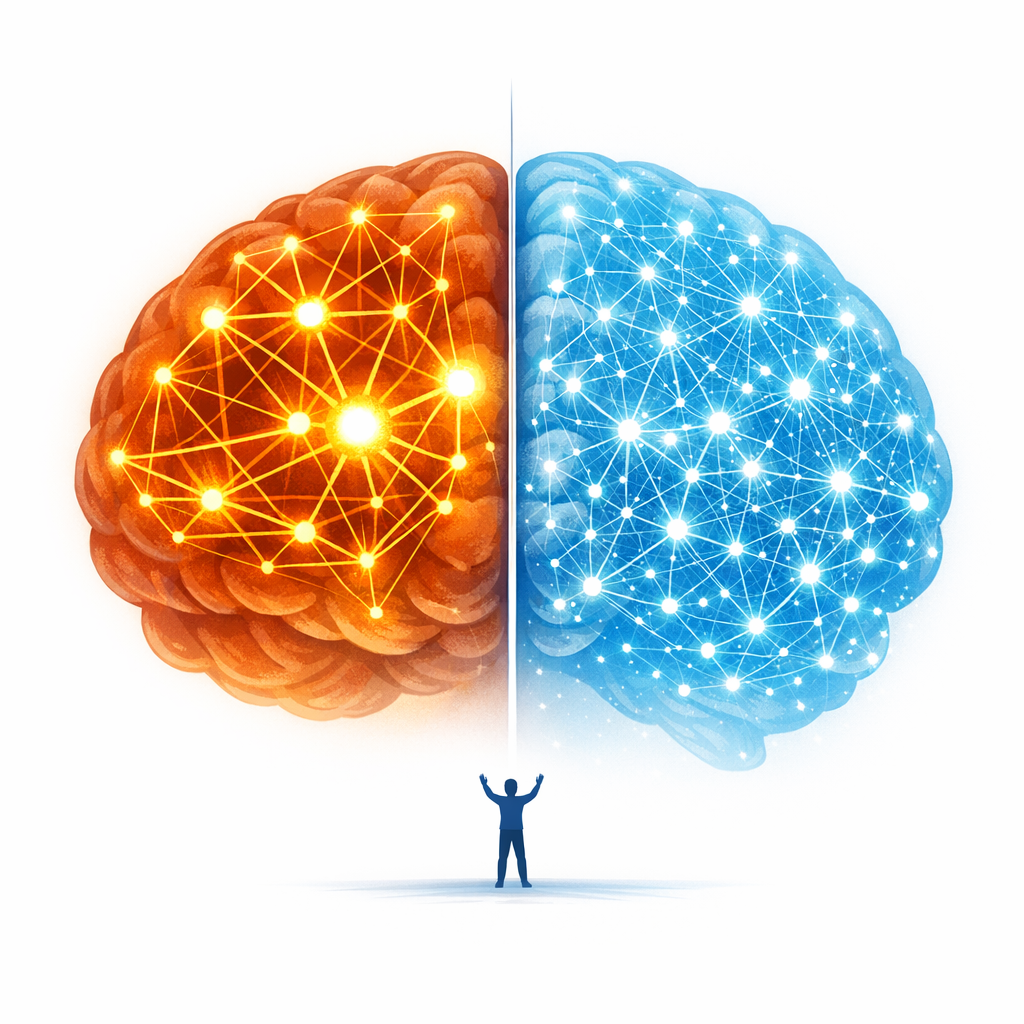
Two brain scans side by side: DMN blazing warm amber on the left (the ordinary mind, always on), dimmed to cool blue on the right (the psilocybin state, freed). Thousands of new connections lighting up across the whole brain on the right. The before and after as the chapter's argument.