
Lsd
LSD
TL;DR: The molecule that started everything — synthesized by accident in a Swiss lab in 1938, it catalyzed both the first wave of psychedelic research and the countercultural backlash that ended it, and remains the most culturally freighted compound in the book.
Spoiler-light. Covers LSD's history and Pollan's experience, as described in the book.
Snapshot
Lysergic acid diethylamide — LSD-25 — was synthesized by Albert Hofmann at Sandoz Pharmaceuticals in Basel, Switzerland in 1938, and its psychedelic properties were discovered accidentally when Hofmann absorbed a trace dose through his fingertips in 1943. He rode his bicycle home while tripping, an event now commemorated annually as "Bicycle Day." What followed was three decades of extraordinary scientific and cultural history: legitimate psychiatric research, celebrity endorsements, Timothy Leary's catastrophic evangelism, government suppression, and now a cautious scientific revival.
Role in the story
LSD appears in three distinct registers in the book. In the historical chapters, it is the engine of the first wave — the compound Sandoz distributed to researchers, the substance Al Hubbard used to transform business leaders and politicians, and the cultural lightning rod that enabled the government to shut down a generation of research. In the personal memoir chapter, it is the substance of Pollan's first guided trip: a 10-hour journey alongside his wife, arriving at "Love is everything" as felt truth rather than platitude. And throughout the neuroscience, it is the synthetic cousin of psilocybin — sharing the same DMN-suppressing mechanism but with a longer duration and somewhat different experiential character.
What makes it distinct
LSD is more synthetic, more precise, and more culturally burdened than psilocybin. It lasts 10–12 hours (versus psilocybin's 4–6). It is associated, in the popular imagination, with the 1960s counterculture, Timothy Leary, and bad trips — a cultural residue that has made legitimate research harder to conduct and harder to fund. Pollan takes LSD first among his three guided experiences, and he finds it more geometric, more intellectually structured than psilocybin.
What it does
Like psilocybin, LSD primarily acts on serotonin 5-HT2A receptors, suppressing the Default Mode Network and temporarily removing the ego's grip on perception. The experience Pollan describes: moving through life stages with his wife, arriving at emotional truths that feel too obvious to have missed, love as a physical reality rather than a concept. "A platitude," he writes, "is precisely what is left of a truth after it has been drained of all emotion."
Visual identity
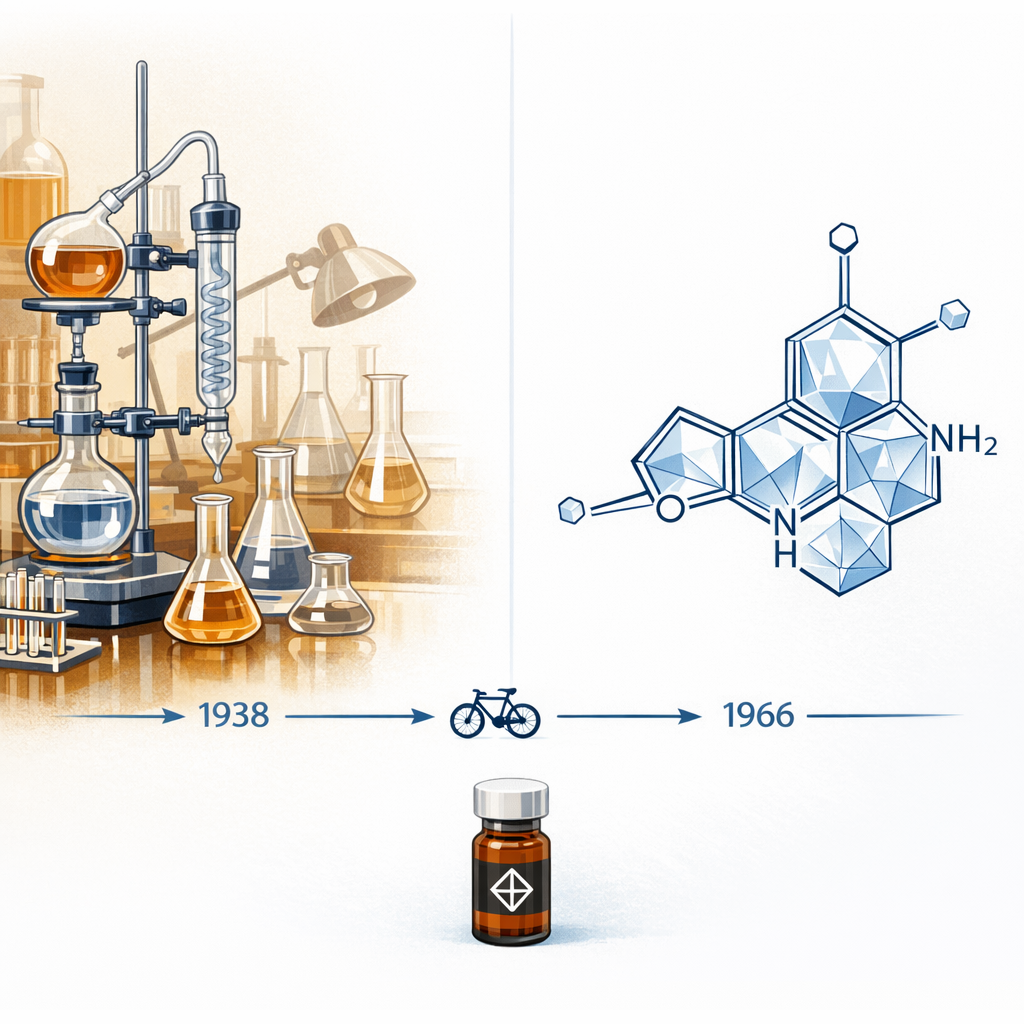
A single blotter-paper square held up to light. Albert Hofmann's 1938 Basel laboratory: glass flasks, chrome equipment, mid-century precision. The distinctive brown Sandoz vials in which LSD was distributed to researchers until 1966. A bicycle — the one Hofmann rode home.
Aliases
The following names and references in the book all point to this concept. Use any of these as link anchors back to this page.
- LSD (canonical — the most common form)
- LSD-25
- lysergic acid diethylamide
- acid (popular name; used sparingly in the book)
Discussion questions
- LSD's history is a case study in how cultural associations can override scientific evidence. How do you think about a compound that has been simultaneously a legitimate psychiatric tool and a cultural symbol of disorder?
- Pollan's LSD experience is different in character from his psilocybin experience — more geometric, more intellectual. Why might two compounds with similar neurological mechanisms feel experientially different?
- Timothy Leary bears significant responsibility, in the book's telling, for the suppression of psychedelic research. Is it fair to hold one person accountable for a policy outcome? What could have been different?