
Robin Carhart Harris
Robin Carhart-Harris
TL;DR: The Imperial College neuroscientist who put psychedelics in fMRI scanners and found something nobody expected — the brain doesn't light up on psilocybin, it quiets down — and then built the Entropic Brain Theory that gives the book its neurological spine.
Spoiler-light. Covers Carhart-Harris's work as described in the book.
Snapshot
Robin Carhart-Harris is a neuroscientist at Imperial College London who, working with pharmacologist David Nutt, produced the first rigorous fMRI data on psilocybin's effects on the brain. His finding — that psilocybin decreases activity in the Default Mode Network rather than activating the brain wholesale — was counterintuitive enough to require explanation. The explanation he developed, the Entropic Brain Theory, turned out to be one of the most elegant frameworks in the book: it accounts not just for psychedelics but for why depression, addiction, and OCD respond to them, and what consciousness actually is.
Role in the story
Carhart-Harris is Chapter 5's protagonist and the source of the book's neurological backbone. Where Roland Griffiths established that psychedelics can occasion genuine mystical experiences with lasting therapeutic benefit, Carhart-Harris explains why, at the level of brain function. Together they provide the scientific foundation for the book's central argument.
What he found
The first surprise: psilocybin suppresses, rather than activates, the DMN. The more suppressed the DMN, the deeper the ego dissolution and the higher the mystical experience score. This means the experience isn't about chemicals flooding a system — it's about removing a constraint.
The second insight: the brain on psilocybin forms thousands of new connections between networks that normally don't communicate. It becomes, in Carhart-Harris's framing, more entropic — more random, more flexible, more connected across regions. This is what he calls the "entropic brain" state.
The Entropic Brain Theory
Carhart-Harris proposes that brain states exist on a continuum from low entropy (excessive order: depression, OCD, coma) to high entropy (excessive disorder: psychosis, mania). Most healthy brains operate in the middle, but mental illness often represents a collapse toward one extreme. Depression, addiction, and OCD are disorders of too much order — the DMN has locked into rigid, self-reinforcing patterns that don't update. Psilocybin temporarily shifts the system toward higher entropy, dissolving rigid patterns and allowing a reset. The therapeutic window is the sweet spot: enough entropy to break the loops, not so much as to produce psychosis.
Why the frame matters
The Entropic Brain Theory reframes the entire moral narrative around psychedelics. "Your brain on drugs" — the frying egg, the chaotic mess — inverts: psychedelics don't create disorder in an orderly brain; they temporarily dissolve excessive order in a brain that has become too rigid. The treatment for too much order is, carefully administered, more entropy.
Visual identity
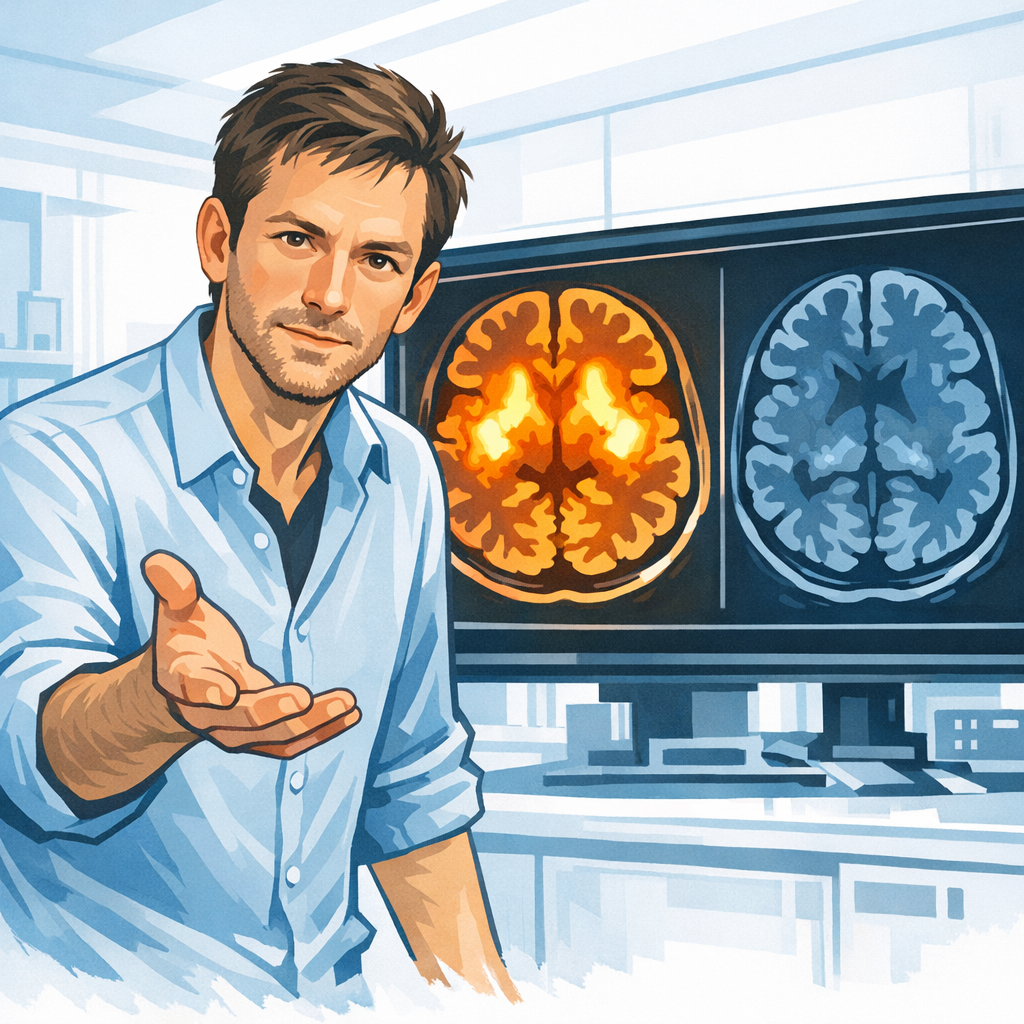
A young British neuroscientist leaning forward, explaining a brain scan. fMRI images of the DMN blazing, then dimming. The Entropic Brain dial: from coma to psychosis, with a therapeutic zone in the middle.
Aliases
The following names and references in the book all point to this person. Use any of these as link anchors back to this page.
- Robin Carhart-Harris (canonical — the most common form)
- Carhart-Harris
Discussion questions
- Carhart-Harris's Entropic Brain Theory reframes many mental illnesses as disorders of excessive order rather than disorder. Does this change how you think about depression, addiction, or OCD?
- The finding that psilocybin suppresses the brain was the opposite of the expected result. What does it suggest when a drug that produces expansive, complex experiences works by quieting a network rather than activating one?
- The theory implies that the brain benefits from entropy — from looseness and disorder — at certain moments. When else in life do we recognize that rigidity itself is the problem?