
Chapter 11
The chapter in one sentence
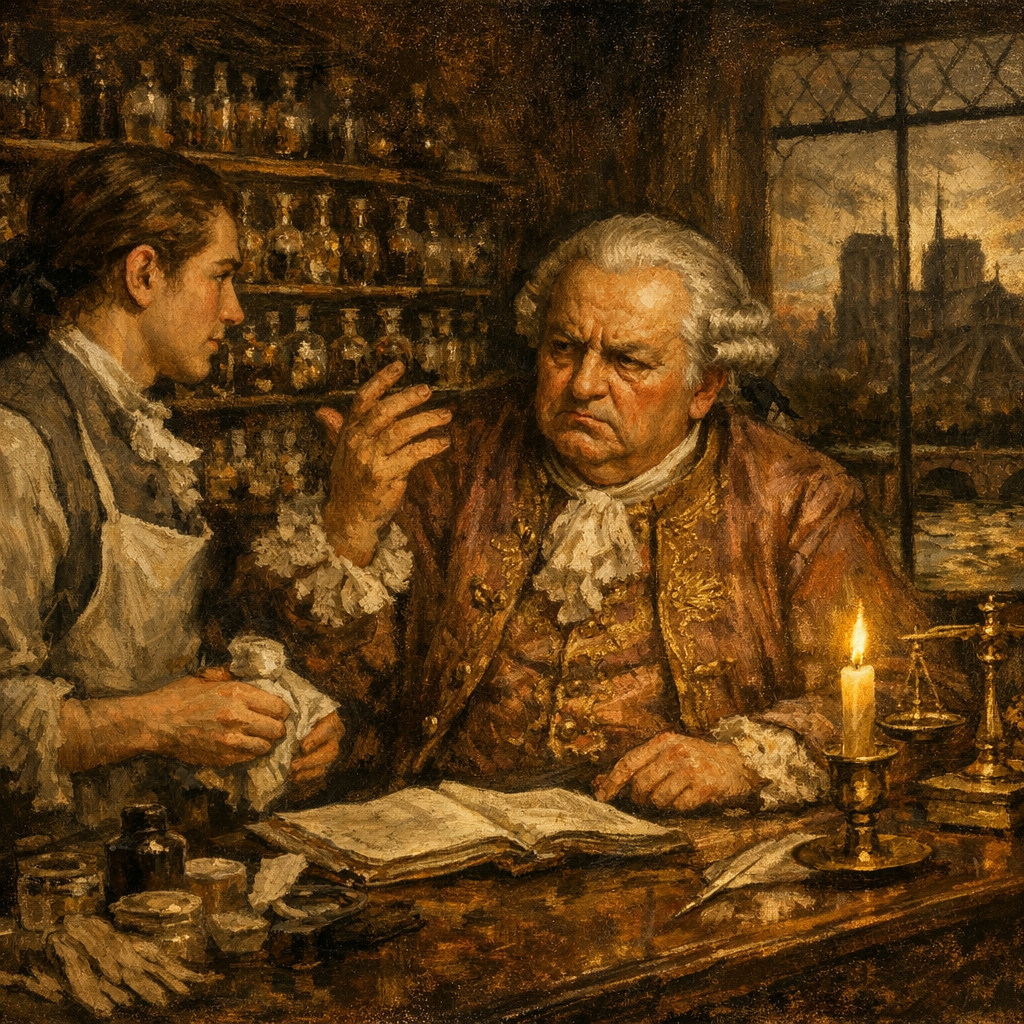
TL;DR: In a dim, gilded, river-lapped shop on the Pont au Change, the proud but fading Italian-trained perfumer Giuseppe Baldini fumes to his apprentice Chénier over the rise of his rival Pélissier and the celebrated new fragrance Amor and Psyche, and reluctantly resolves to copy it — setting up the demand that the boy at his door in two chapters will satisfy.
Spoilers through Chapter 11.
Süskind introduces the master perfumer who is about to receive the protagonist, and gives him exactly the commercial anxiety that will make Grenouille irresistible.
What happens
Baldini's shop is a museum-piece of his own former taste — mahogany shelves stacked with hundreds of glass flacons, alabaster jars, brass scales, silk pomanders, leaded panes opening onto Notre-Dame and the green-brown Seine. The chapter is a portrait of declining commerce. Trade is down; the upstart Pélissier has captured fashionable Paris with Amor and Psyche; Baldini is contemplating the sale of his shop. He fumes to Chénier — his calm, deferential apprentice — about the indignity of having to copy a rival's perfume to stay solvent. He brews himself into the resolve to do it anyway.
The chapter is almost entirely interior to the shop. Grenouille is not on the page. The reader is being told, in advance, what the boy is going to walk into, and why a master perfumer might consider buying a tannery apprentice's labor to relieve his anxiety.
Key moments
- The shop interior. Süskind's first sustained description of the perfumer's environment — the visual and material world of glass, brass, and silk that will be Grenouille's playground.
- The grievance. Baldini's monologue against Pélissier — comic, theatrical, pathetic, period-accurate.
- The resolution. He will copy Amor and Psyche. He has no idea how. The plot has been threaded.
Character shifts
Baldini moves from passive decline to active grievance. Chénier is established as patient, modest, the floor of the trade. The reader knows what kind of man is about to be handed a miracle.
Why it matters
The chapter is preparation. None of its plot beats matter independently; all of them matter as the condition under which Grenouille's gift will land. Süskind is also using Baldini's nostalgia to give the book one of its most affectionate set-pieces — a perfumer's shop on the Pont au Change in 1750, lovingly rendered.
Themes to notice
- The artist as monster — its inverse: the competent ordinary tradesman, who is sympathetic and limited at the same time.
- Worship as the most dangerous reflex — its commercial form: the way fashionable Paris flocks to Amor and Psyche without examining why.
Book club questions
- Baldini is presented as a small businessman in genuine distress. Does the book want you to like him? Pity him? Both?
- Chénier is in the shop the whole chapter. The reader barely registers him. What does the prose's lack of interest in the apprentice tell you about its priorities?
Visual memory hook
An aging Italian perfumer in a dusty-rose silk waistcoat and a powdered wig, fluttering long-fingered hands at a ledger, brooding under a brass oil lamp in a shop full of glass flacons, with the green-brown Seine through the leaded panes behind him.
What's next
Chapter 12 brings the boy in question to the door of this shop in Grimal's grip, and produces the bargain that will make the rest of Part 1 possible.