
Chapter 13
The chapter in one sentence
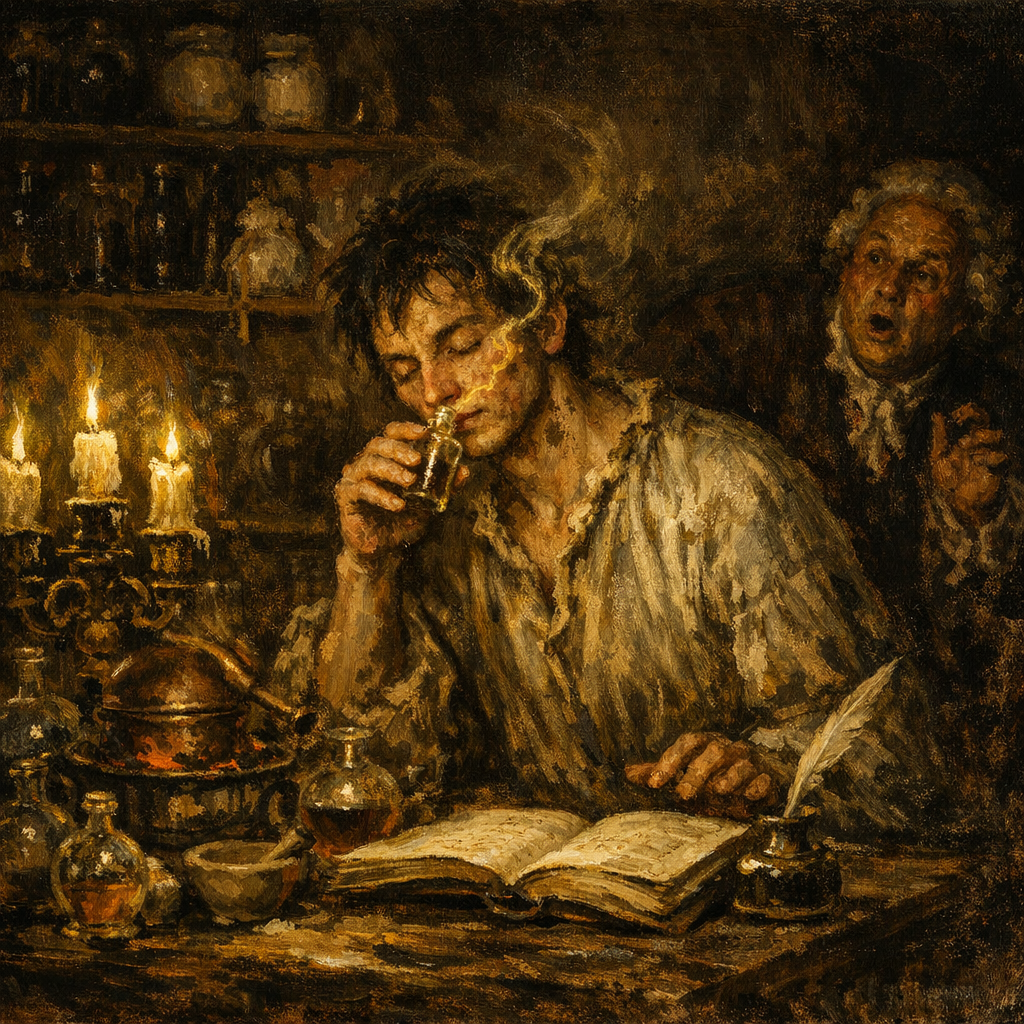
TL;DR: In Baldini's candlelit back-room laboratory over the Seine, Grenouille smells a vial of Pélissier's celebrated Amor and Psyche, calmly announces he can recreate it, and proceeds — without recipe, without measurements, without any formal training — to compound a perfect duplicate by nose alone, leaving Baldini shaken to the foundations of his trade.
Spoilers through Chapter 13.
The audition that turns the apprenticeship from charity to commerce — and quietly inverts the master-pupil relationship for the rest of Part 1.
What happens
Baldini, intending to test the boy's nose with a smelling exercise, hands Grenouille a vial of Amor and Psyche — the rival's perfume he has been brooding over since chapter 11. He expects the boy will fail or, at best, identify the obvious notes. Grenouille smells the vial, names every component, and announces that he can make it.
He then does make it, in front of Baldini, by walking among the shelves of essences and pouring directly into a glass beaker — no scale, no formula, no instructions. The product is identical to Amor and Psyche. Better, even. Baldini, watching, is undone. The chapter ends with the master perfumer, fluttering hands frozen in mid-gesture, looking at his apprentice the way Father Terrier looked at the bundle in chapter 3.
Key moments
- The vial. Baldini's intended trap. Grenouille's actual prize.
- The smelling. Grenouille's blank silent precision in identifying every note. Süskind grants this a paragraph of clinical wonder.
- The compounding. No recipe, no balance, no hesitation. The boy walks among the essences as if he had been raised in the shop.
- The mouth-O. Baldini, registering exactly what he has just hired.
Character shifts
Baldini moves from grudging buyer to terrified beneficiary. Grenouille moves from a tannery boy presented as cheap labor to a force of nature. Their relationship is now formally a master-apprentice arrangement and structurally the inverse.
Why it matters
This is the chapter Baldini's commercial trouble disappears and his existential trouble begins. From here forward Baldini's shop will produce, weekly, perfumes Grenouille has improvised in fifteen minutes — and Baldini will spend every night writing them down as if they were his own. The reader knows; Pélissier doesn't; the boy doesn't care.
Themes to notice
- The artist as monster, the monster as artist — its first sustained demonstration. Grenouille is the only person in the shop who is actually doing perfumery; the man who calls himself a master is, in this chapter, a clerk.
- Smell as the sense reason can't argue with — operationalized for the first time as economic value.
Book club questions
- Süskind grants Grenouille no rehearsal, no failed attempt, no learning curve. He simply can do this. Is the lack of process a problem for the book — or its central honest fact?
- Baldini's reaction is shock, not joy. Why?
Visual memory hook
A small dark hunched figure at a candlelit perfumer's table, holding an open glass flacon to his face, eyes half-closed — and an aging master in a powdered wig staring at him with a hand half-raised and a mouth in a small terrified O.
What's next
Chapter 14 closes the deal: Grimal returns the next evening, money changes hands across the worktable, and Grenouille is formally Baldini's property — until he isn't.