
Chapter 2
The chapter in one sentence
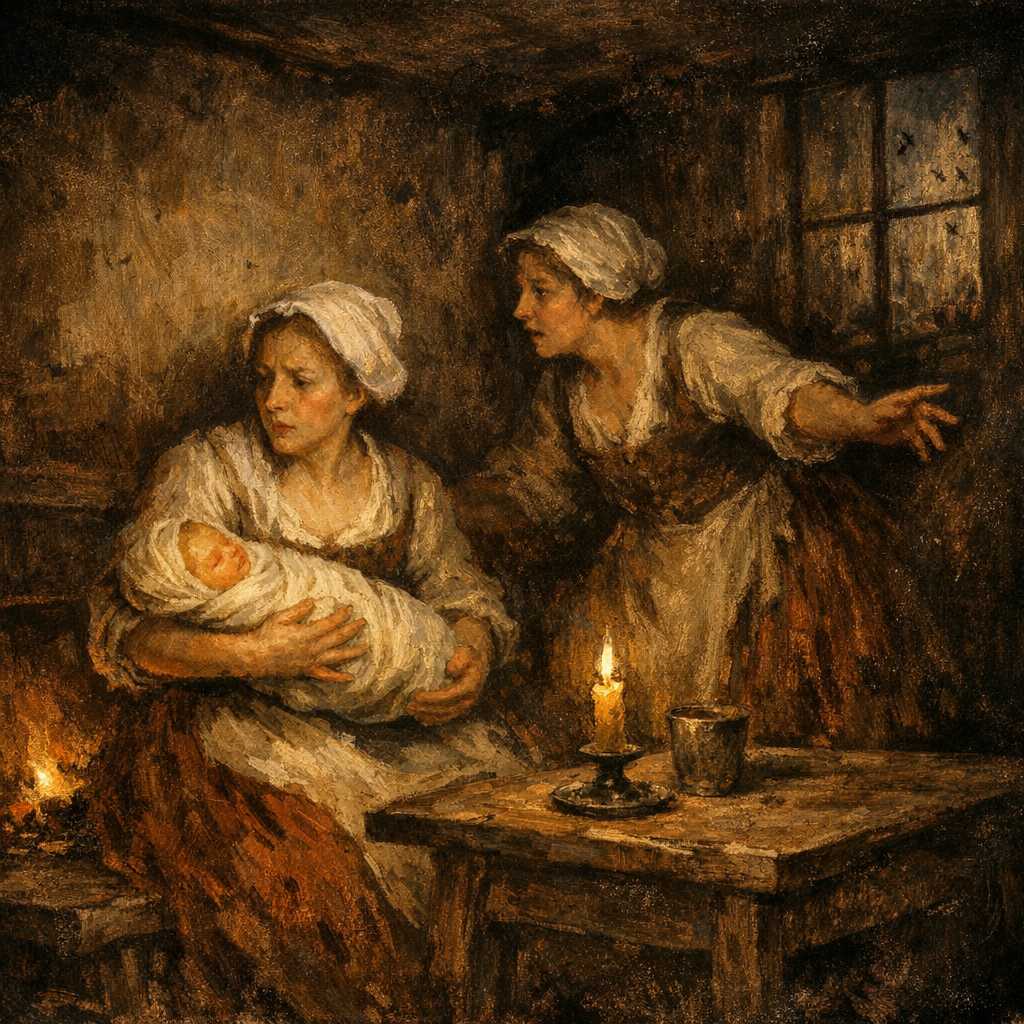
TL;DR: Passed from breast to breast across Paris, the newborn Grenouille is returned again and again — "too greedy," too quiet, and most disturbingly carrying no baby-smell at all — until the wet nurse Jeanne Bussie carries him bundled through the alleys to Father Terrier and demands the parish take the strange child back.
Spoilers through Chapter 2.
The Parisian women whose job is to recognize what babies smell like deliver, in plain language, the diagnosis the rest of the book is going to spend 250 pages confirming.
What happens
Grenouille is shunted out of the parish into the wet-nurse system. He passes through several arrangements in succession and is returned each time. The official complaint — "too greedy" — masks a stranger one. The women lift him to their breasts, feed him, glance at one another, and refuse to keep him because the infant in their arms emits no warm baby smell at all. None of the milky-skin-and-scalp odor every other infant they have ever held produced. The garrets fill with whispered theories: changeling, devil's get, something wrong.
Jeanne Bussie, the most blunt and pragmatic of the women, finally walks the bundle back to the parish herself. She strides through Paris alleys past gutter offal and slick cobbles, the swaddled infant a silent weight in yellowed linen. She arrives at the parish office of Father Terrier at Saint-Merri, lays the bundle on his desk, and tells him in plain language that the child has no smell.
The chapter ends with Terrier preparing to handle the problem in what he considers a more rational fashion. The next chapter will reveal what rational costs him.
Key moments
- The succession of refusals. Süskind's compressed list of nurses returning the infant builds an unsettling rhythm: this is a child the body recognizes as wrong before the mind has a vocabulary for it.
- Jeanne Bussie's walk through Paris. The chapter's middle is a working woman's purposeful stride through the Marais — her decision visible in her body before it reaches the priest.
- "He has no smell." A working-class woman's plain-language diagnosis to an educated cleric. The line will reverberate through every later chapter where someone tries to tell the truth about Grenouille and isn't heard.
Character shifts
Jeanne Bussie steps into the book as the first character to perceive Grenouille correctly. Father Terrier appears at the end of the chapter set up to make an Enlightenment-rationalist mistake. Grenouille remains a bundle.
Why it matters
Süskind establishes here the book's signature pattern: working-class women, especially those who handle babies, are correct about Grenouille faster than anyone else. The educated men around him — clerics, perfumers, marquises — will spend chapters hiding from what the wet nurses know in five minutes. The book is, among other things, an argument about where reliable perception lives in pre-Revolutionary France, and it does not live in the rectories.
Themes to notice
- Smell as the sense reason can't argue with — Bussie cannot articulate what is wrong, only that something is. She is right.
- Identity as something you have to make for yourself — Grenouille's defining absence (no smell) is named here. The rest of his life is a response to it.
- Worship as the most dangerous reflex — its inverse: superstitious aversion, also unreliable, also closer to the truth than the priest will admit.
Book club questions
- Süskind has Bussie use the language of the devil, and Terrier in the next chapter dismisses that language as superstition. Is the book's sympathy with Bussie's accuracy or with Terrier's framework — or with neither?
- None of the wet nurses are named except Bussie. Why grant her the name?
- The chapter is built on a sense — smell — that prose normally has trouble representing. How does Süskind manage to give you the absence of a smell?
Visual memory hook
A working woman in a soiled linen apron and cap, striding purposefully through a refuse-strewn Paris alley with a swaddled infant held away from her body, on her way to argue with a priest.
What's next
Chapter 3 puts Bussie and Terrier in the same room over the bundle, and lets Süskind do something the book will repeat many times: stage a scene where the educated authority figure is condescendingly wrong in real time.