
Chapter 21
The chapter in one sentence
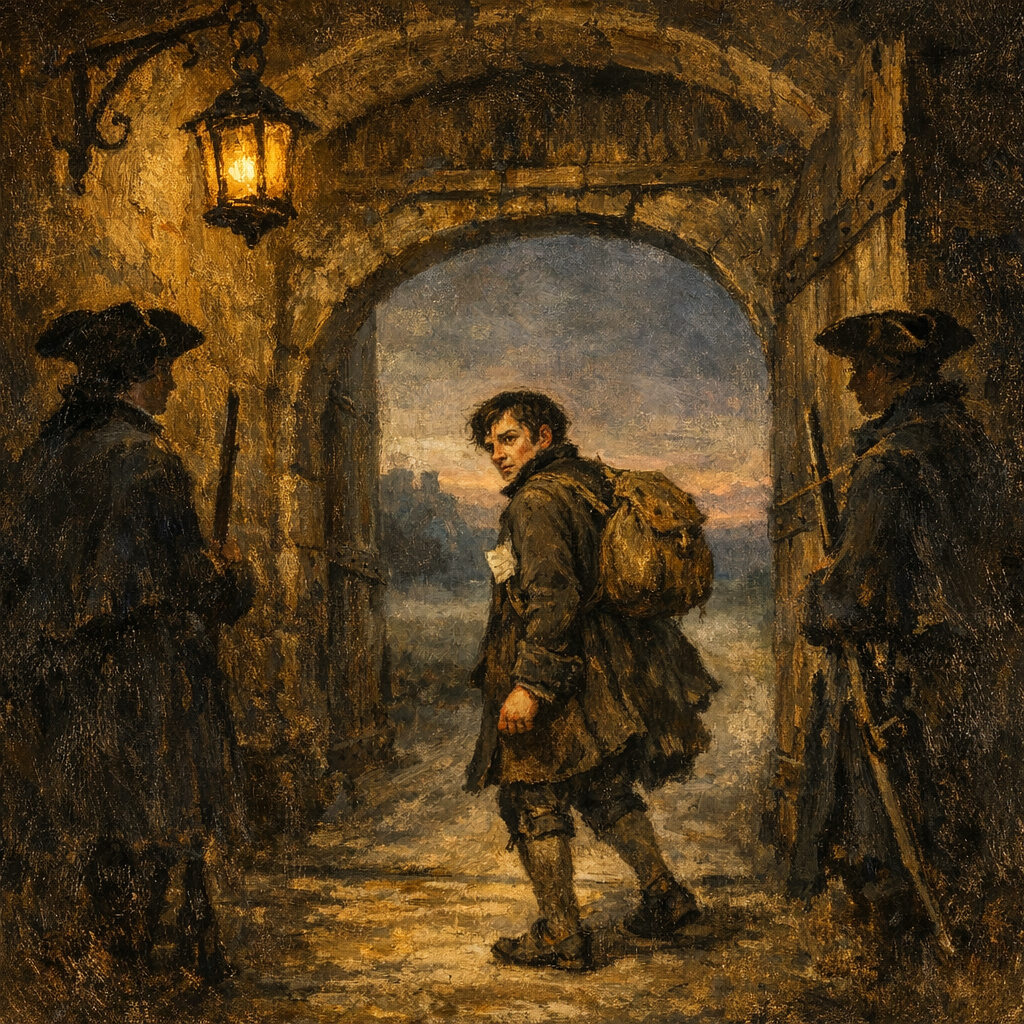
TL;DR: Grenouille slips out of Paris through a southern city gate at dawn with the journeyman's pass folded in his coat, the city's reek behind him, and the open dirt road ahead — and turns his back on Paris for what the reader will only later realize is sixteen years.
Spoilers through Chapter 21.
The protagonist exits the city he has been catalogued by for two decades, and the prose performs a small relief that the reader is meant to feel with him.
What happens
Predawn at one of the city's southern gates. Two sentries silhouetted in tricorns under a guttering lantern, the bruised sky beyond shading toward pale rose. Grenouille walks under the arch with his pack on his shoulder and the folded vellum of his journeyman's pass tucked into his coat. He turns once, briefly, to look back at the city. He does not linger.
The chapter is a transition piece, but it is also the first time the prose lets air into the book. After twenty chapters of fish markets, lime pits, candlelit interiors, and crowded Paris alleys, Süskind opens the camera onto an empty country road. The change of register is its own argument.
Key moments
- The arch. A small figure crossing a stone threshold from one life to another.
- The look back. Süskind grants him exactly one. He does not romanticize it.
- The road ahead. Open dirt, low ground-fog, a horizon. The visual antithesis of every Paris chapter that has preceded it.
Character shifts
Grenouille is now legally a free journeyman. He is also, for the first time in the book, in open country, with no employer and no destination he has yet chosen. The next ten chapters will be entirely about his relationship to the species he has just walked out of.
Why it matters
The chapter is the book's structural pivot from Part 1 to Part 2. The Paris arc is over; the road south, the cave, the Marquis, and Grasse are ahead. It is also Süskind's small kindness to the reader — the single chapter in Perfume in which the protagonist is only walking, only breathing, only leaving.
Themes to notice
- Identity as something you have to make for yourself — Grenouille is now formally his own.
- Pre-Revolutionary France as a body that knows it's rotting — and the book begins, briefly, to render the country outside the city, which has its own rhythms and is not yet ruined.
Book club questions
- The chapter is short and quiet. Why does it land the way it does?
- Süskind grants Grenouille one backward look. Is the book sentimental about Paris in this moment, or merely accurate about the human reflex?
Visual memory hook
A small thin figure under a stone gate-arch at dawn, lantern guttering above, sentries silhouetted on either side, an open dirt road stretching south into a pale-rose horizon.
What's next
Chapter 22 returns to Paris in the same night Grenouille leaves it, and gives Baldini the ending the book has been preparing for him.