
Chapter 24
The chapter in one sentence
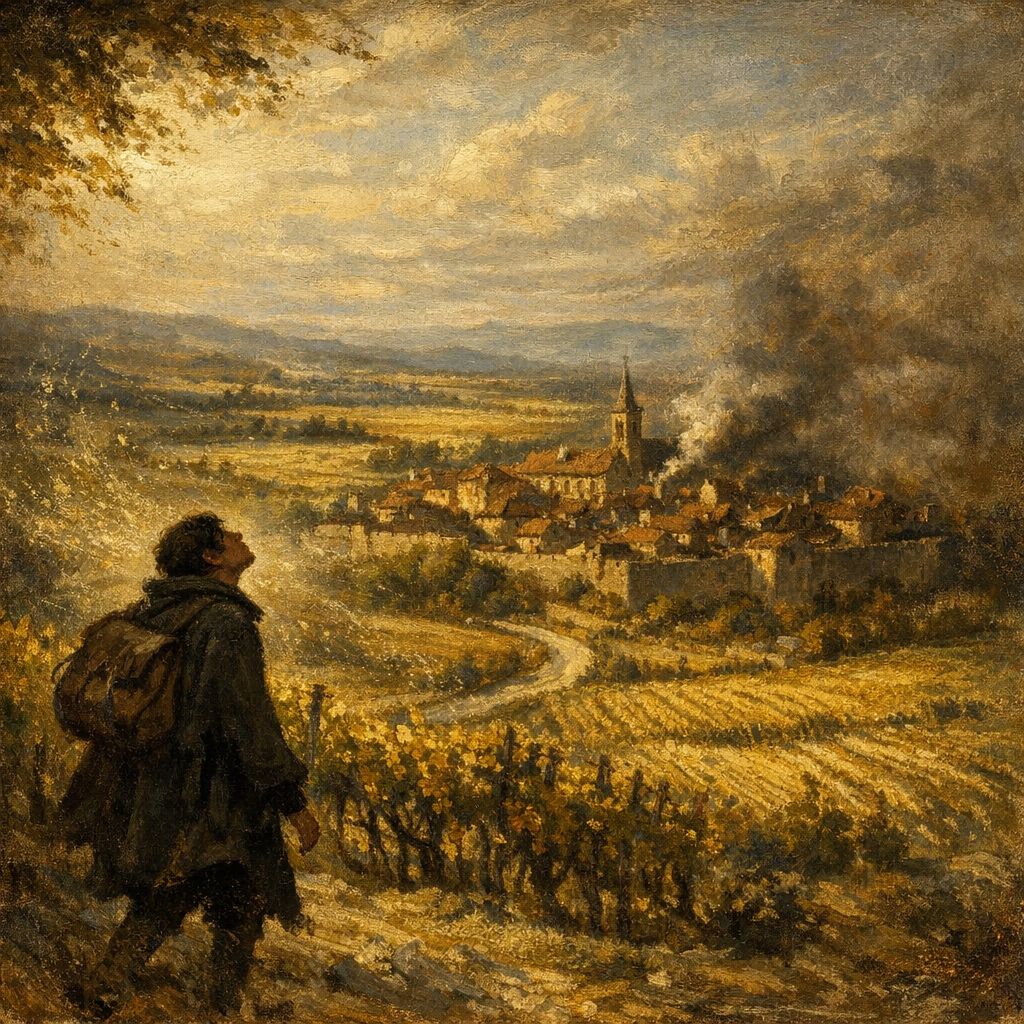
TL;DR: Overwhelmed by the human stench radiating from every town he approaches, Grenouille abandons the roads entirely and starts navigating cross-country by clean winds and mineral scents alone, looking for somewhere people aren't.
Spoilers through Chapter 24.
The protagonist's pastoral pleasure of chapter 23 fails its first test, and the book leaves the human world behind by degrees.
What happens
Grenouille can smell the next town from miles away. The cesspits, the abattoirs, the laundry-troughs, the stables, the human bodies — the entire signature of any 1750s settlement is, to his nose, intolerable. He stops short of villages, recalibrates, cuts cross-country through stubble and vineyards. The road south becomes a personal trigonometry of avoidance.
He still moves south, but now without infrastructure: no inns, no roads, no human contact. He sleeps in fields. He eats whatever roots and stale bread he carries. The chapter is the withdrawal chapter — the rejection of the species he was born into, performed by walking.
Key moments
- The town from a mile off. Grenouille halting, lifting his head, recoiling. The book's clearest physiological argument that human settlements stink in proportion to their populations.
- The cross-country detour. The map of France in his head reorganizing itself around what he can avoid.
- The thinning landmarks. Towns become rumors in the distance.
Character shifts
Grenouille discovers what was always implicit: he does not want to be among people. The book is now committed to staging the protagonist's withdrawal at the geographic limit possible in 18th-century France.
Why it matters
The chapter is the bridge between the country pleasure of chapter 23 and the cave decision of chapter 25-26. It also gives the book one of its most defensible — and most uncomfortable — moral arguments: there is something to recoil from in the species that produced Grenouille. Süskind does not endorse the recoil; he simply lets it happen.
Themes to notice
- Identity as something you have to make for yourself — by subtracting humans from the construction.
- Smell as the sense reason can't argue with — Grenouille's nose is going to drive him into the most uninhabited place in France.
Book club questions
- Süskind makes the towns objectively unbearable to Grenouille's nose. The reader is asked to share the recoil, at least briefly. Is the book on his side here? Where does it stop being?
- The protagonist has, quietly, given up on the species. Does the book want you to read this as misanthropy, ascesis, or psychiatric collapse?
Visual memory hook
A small thin figure on a high vineyard ridge looking down across a panorama of golden fields with a small walled town in the middle distance, halted mid-step, head tilted slightly back, recoiling.
What's next
Chapter 25 finds him the most uninhabited point in France.