
Chapter 32
The chapter in one sentence
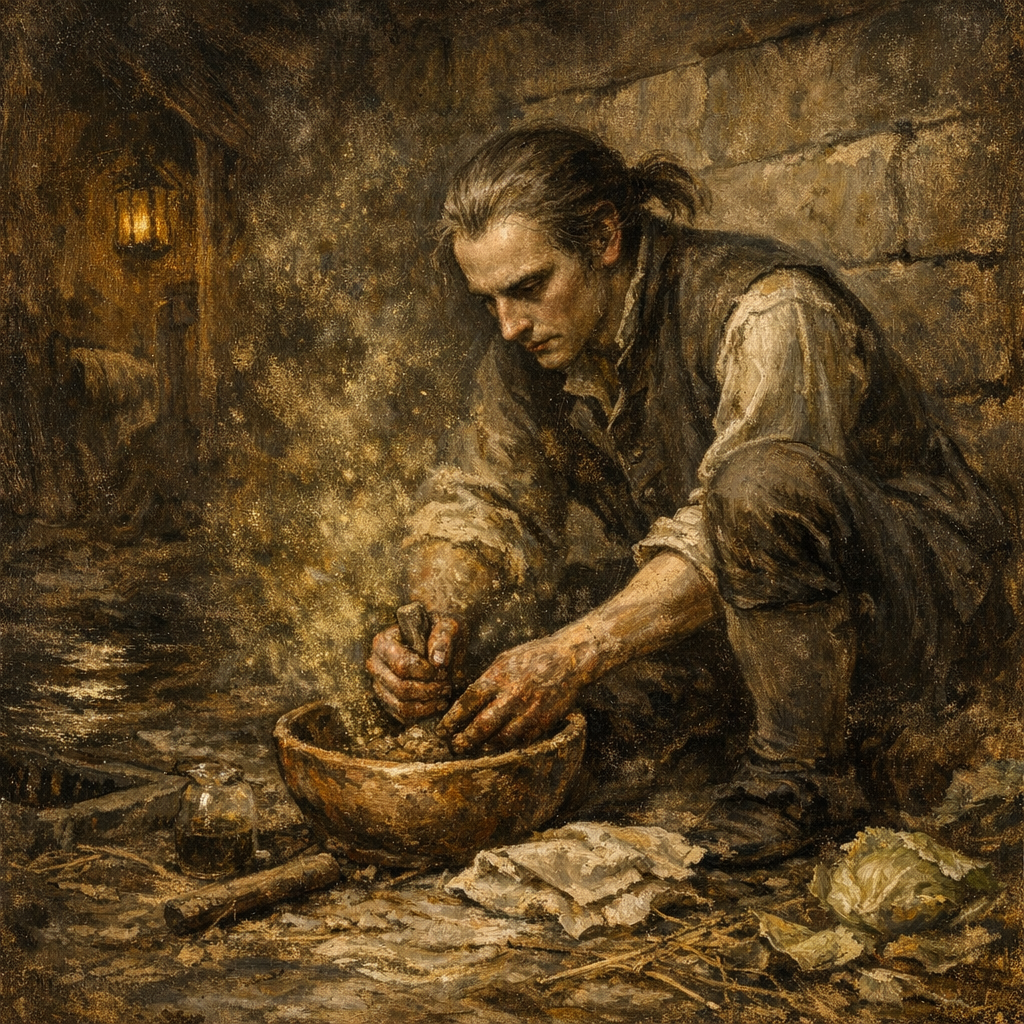
TL;DR: Grenouille slips into a Montpellier back-alley, blends a crude "human smell" out of cat dung, sour cheese rind, vinegar, and other foul ingredients, dabs the resulting paste on his wrists and neck, and walks back into the streets — and is, for the first time in his life, seen by passing strangers as an ordinary man.
Spoilers through Chapter 32.
The protagonist completes the project the cave catastrophe set him on, and demonstrates the result on the species that has spent a lifetime not registering him.
What happens
A filthy back-alley behind a Montpellier inn. Damp straw, a stone drain, scattered cabbage leaves. Grenouille — calm, methodical, freshly groomed in plain dark wool waistcoat and breeches over the absurd court silks of the prior chapter — crouches and grinds his recipe in a chipped clay bowl: cat dung, sour cheese rinds, a splash of vinegar, a few other ingredients the prose names with clinical interest. The result is a brown-ochre paste that smells, to anyone with an ordinary nose, exactly like a working-class human body.
He dabs the paste at his wrists and neck. He walks back into the street. The passing strangers look at him — normally. They register him. They do not glance away. They do not flinch. He is, by olfactory standards, a man.
Key moments
- The recipe. Süskind names every ingredient with chemist's calm.
- The grinding. A small stick used as pestle. The book's cleanest portrait of making something hideous and useful.
- The first registered glance. A stranger's eye lighting briefly on Grenouille and then moving away — the casual perception every other person in 1750s France has been receiving since infancy. He has never had this before.
Character shifts
Grenouille becomes, for the first time, normal. Not loved, not seen, not admired — just registered by his species. The chapter is one of the book's most quietly affecting, because what the protagonist gets here is so small and the entire rest of his life has been built around the lack of it.
Why it matters
The chapter is the operational pivot of Part 2. From here forward Grenouille can move through 1750s France without exciting the silent revulsion that has marked every prior interaction. The same technique — masking himself with manufactured scent — will be the engine of the entire Grasse arc.
Themes to notice
- Identity as something you have to make for yourself — and what the making, in this case, is literally made of.
- Smell as the sense reason can't argue with — including, here, the reverse: a cheap synthetic scent restoring an entire social register.
- The artist as monster, the monster as artist — the artist's first ugly successful prototype.
Book club questions
- Süskind gives the recipe the same prose dignity he gives Baldini's Amor and Psyche. What does the matching register tell you about how the book classifies making?
- Grenouille's first goal once he has the cover is not to commit a murder. He simply walks. Why does the prose grant this small pleasure?
Visual memory hook
A small dark figure crouched in a filthy alley grinding cat droppings, cheese rinds, and a splash of vinegar into a brown paste in a chipped clay bowl, evening light fading, faint dirty-yellow particles rising around him as he applies the result to his own wrists.
What's next
Chapter 33 walks him out of the Marquis's life.