
Chapter 4
The chapter in one sentence
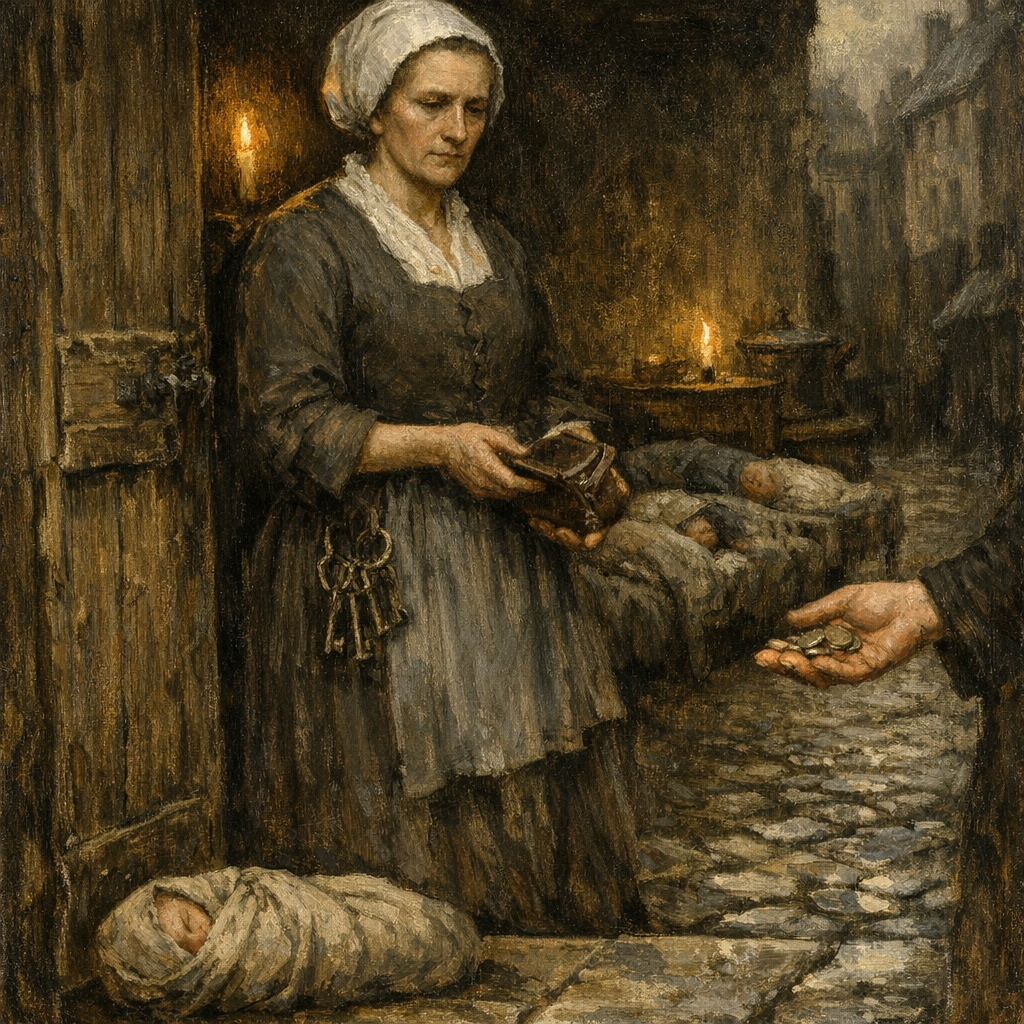
TL;DR: Grenouille is delivered to Madame Gaillard's emotionless boarding house on rue de Charonne, where the proprietress's anosmia — a souvenir of a childhood blow from her own father — leaves her unable to perceive what is wrong with him, and his scentless silent childhood passes through years of cabbage broth and straw pallets without anyone in the household noticing he exists in any unusual way.
Spoilers through Chapter 4.
Süskind solves the structural problem of Grenouille's survival by depositing him in the only household in Paris that cannot perceive what's wrong with him.
What happens
Madame Gaillard receives the bundle at the door of her children's boarding house, takes the parish stipend, and admits Grenouille to a low, smoky, cabbage-sour interior of straw pallets, shared lice, and bowls of pale broth. She runs the house like a ledger: thirty children, thirty bowls of broth, thirty notches on a tally stick, the bare biological floor of survival.
The chapter compresses several years. Grenouille, who has gone through a string of nurses who could not stand him, finds in this house the one environment where his absence registers as nothing remarkable. Gaillard cannot smell him because she cannot smell anything — her sense of smell, and most of her capacity for affect, were destroyed when her father struck her in the head as a child. The other children avoid him with a nameless unease, but children's unease, in this house, has no leverage.
What Grenouille does instead is catalogue. Awake at night while the others wheeze around him, he turns his nose to the dark and begins the project that will dominate the next ten chapters: he is mapping his world by smell — damp plaster, cold iron, child-sweat, the rain-barrel in the yard, the joiner's glue from the next street over, the tannery air drifting in from the faubourg.
Key moments
- The threshold exchange. Gaillard's flat face in the doorway, the parish coins counted, the child admitted. The book's coldest welcome.
- The dormitory at night. Grenouille awake among the wheezing children, his nose making a private taxonomy of the room. The first sustained image of him working.
- The yard and the street edge. A small boy nosing along a rain barrel and a warped gate — already collecting Paris.
Character shifts
Grenouille begins his apprenticeship in scent — informal, unsupervised, conducted entirely in his own head. Gaillard registers nothing. The other children avoid him; the book does not give them names.
Why it matters
The chapter establishes the structural premise that will let Grenouille survive long enough to become the protagonist of a novel. He is unobservable in the only home that could keep him alive. It also seeds the catalogue-of-Paris-by-smell that will feed the entire first half of the book — the book's most compelling uncanny pleasure is Grenouille's nose-map of 1740s Paris, and Süskind starts building it here, in the dark, in a room nobody is watching.
Themes to notice
- Smell as the sense reason can't argue with — and the inverse: a household where smell is absent, which protects the protagonist precisely because no one can use it on him.
- Identity as something you have to make for yourself — Grenouille begins his self-construction in this house, with no teacher, no language, no audience.
- Pre-Revolutionary France as a body that knows it's rotting — the house itself is one organ of the rot.
Book club questions
- Madame Gaillard's anosmia is a structural device. Is Süskind showing us a parable about indifference, or just engineering the plot?
- The other children sense something is wrong with Grenouille and stay away from him. Why give children a reliable instinct the adults don't have?
- The chapter makes Grenouille's central activity cataloguing. He is not yet stealing scents — only learning them. Does the difference matter morally?
Visual memory hook
A small dark-haired boy lying motionless on a straw pallet in a low-ceilinged dormitory, the rain ticking on the tiles, his eyes closed and his nostrils flared, sorting the room into its component smells while the other children sleep.
What's next
Chapter 5 closes Grenouille's residence at Gaillard's by selling him, at age eight, to a Parisian tanner for fifteen francs and a leather pit job that should kill any child within the year.