
Chapter 41
The chapter in one sentence
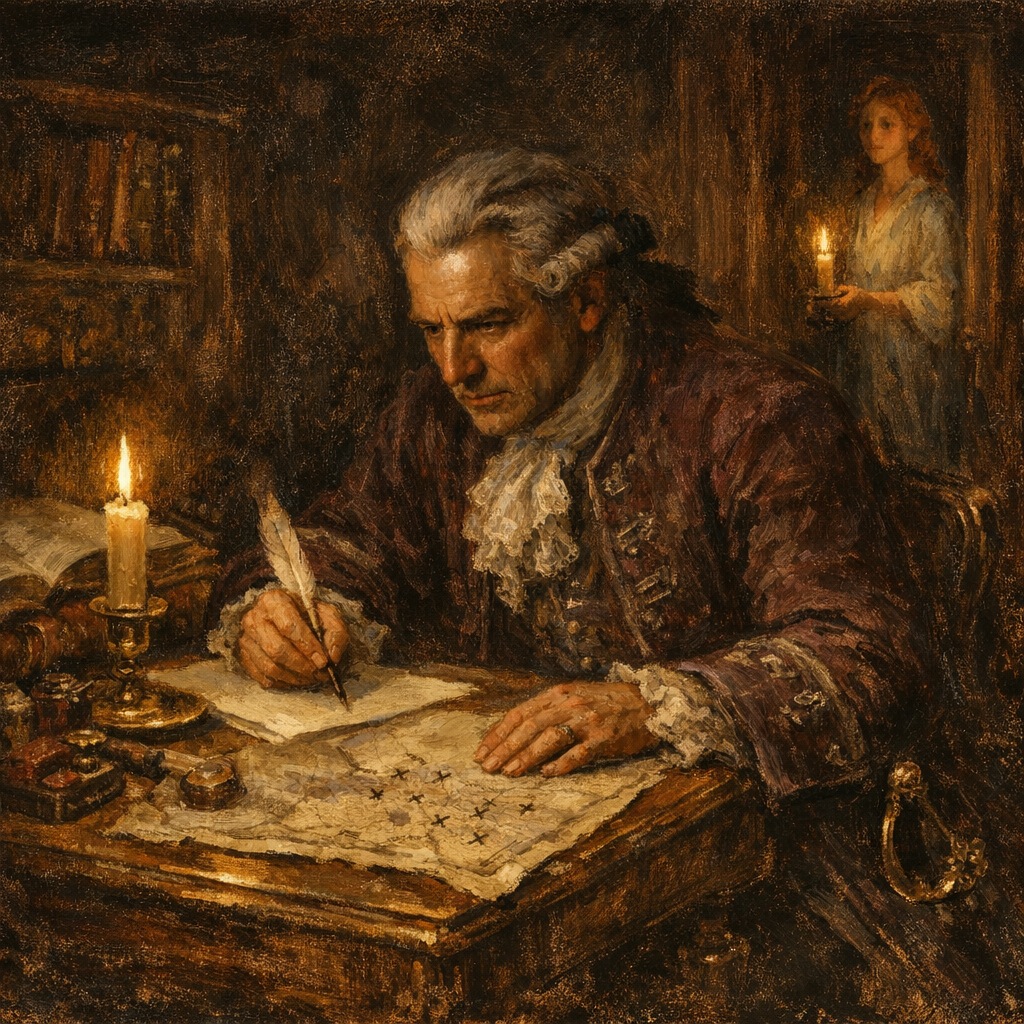
TL;DR: In lamplight and ledger-sharp calm, Antoine Richis profiles the virgin-killer of Grasse — collating the deaths, plotting them on a map, deducing the deliberate pattern — and decides that his daughter Laure must be moved before the murderer claims his finest prize.
Spoilers through Chapter 41.
The only piece of detective work in Perfume, performed alone in a candlelit study, by a man whose intelligence will not be enough to save his child.
What happens
Antoine Richis's study in his Grasse townhouse, late candlelit night. A walnut desk; leather-bound civic ledgers stacked open; a parchment map of Grasse spread flat with small inked crosses scattered across one quarter of the page (the murder locations). A single tallow candle. A wax-seal kit. A quill in a brass standish. A small glass of dark wine.
Richis works through the cases methodically. He notices what the bishop and the magistrates have not: the murders are not random. The killer has been working through the most beautiful young women of Grasse, in a sequence that, plotted geographically and by victim attribute, points unmistakably toward a final keystone — Laure Richis, sixteen, copper-haired, the beauty of Grasse. Richis finishes the deduction at his desk and decides to flee with her before dawn.
Süskind grants this chapter to a single character thinking. There is no drama, no monologue, no panic. Just a magistrate doing the work the city's institutions have failed to do.
Key moments
- The map. Inked crosses on parchment. The chapter's defining image.
- The deduction. Richis seeing the sequence the bishop hasn't.
- The decision. Quiet, complete, irreversible. He will move Laure before sunrise.
Character shifts
Richis becomes, in this chapter, the only real adversary Grenouille has had. The book has been waiting to give us a capable opponent; chapter 41 is where it does.
Why it matters
The chapter is the book's quiet argument that 18th-century Grasse is not without intelligence — it has Richis. The intelligence is just outmatched by the chemistry that walks the streets. The structural tragedy of Part 3 is that the only competent intelligence in the town arrives at the right answer too late, by one chapter.
Themes to notice
- The artist as monster, the monster as artist — and the most painful inverse: the correct intelligence the artist's medium will overwrite.
- Worship as the most dangerous reflex — its inverse: cool deduction. The book grants Richis this quality and then breaks him with it.
Book club questions
- Richis is the first character in the book to see Grenouille for what he is. What in his life — magistrate, widower, single father — has equipped him for the perception?
- Süskind grants the deduction a single quiet chapter. Would the book be different if the deduction had been spread across multiple chapters of investigation?
Visual memory hook
A salt-and-pepper-haired magistrate at a walnut desk in deep candlelight, leaning forward over a parchment map of Grasse with small inked crosses across one quarter of the page, a quill suspended over a fresh sheet, his expression the absolute concentration of a father who has just seen what is coming.
What's next
Chapter 42 pulls back from the study and gives us a luminous portrait of the daughter the chapter has decided to flee with.