
Chapter 43
The chapter in one sentence
TL;DR: Richis spirits Laure out of Grasse before dawn — disguised as common travelers, jewels and silks left behind, a heavy purse in his coat — and they drive north through the cold stony mountain roads toward Grenoble, hoping to outrun the murderer Grasse has not been able to catch.
Spoilers through Chapter 43.
The flight out of Grasse is staged with the brisk economy of a magistrate who has spent his life moving difficult cargoes through the Provençal countryside.
What happens
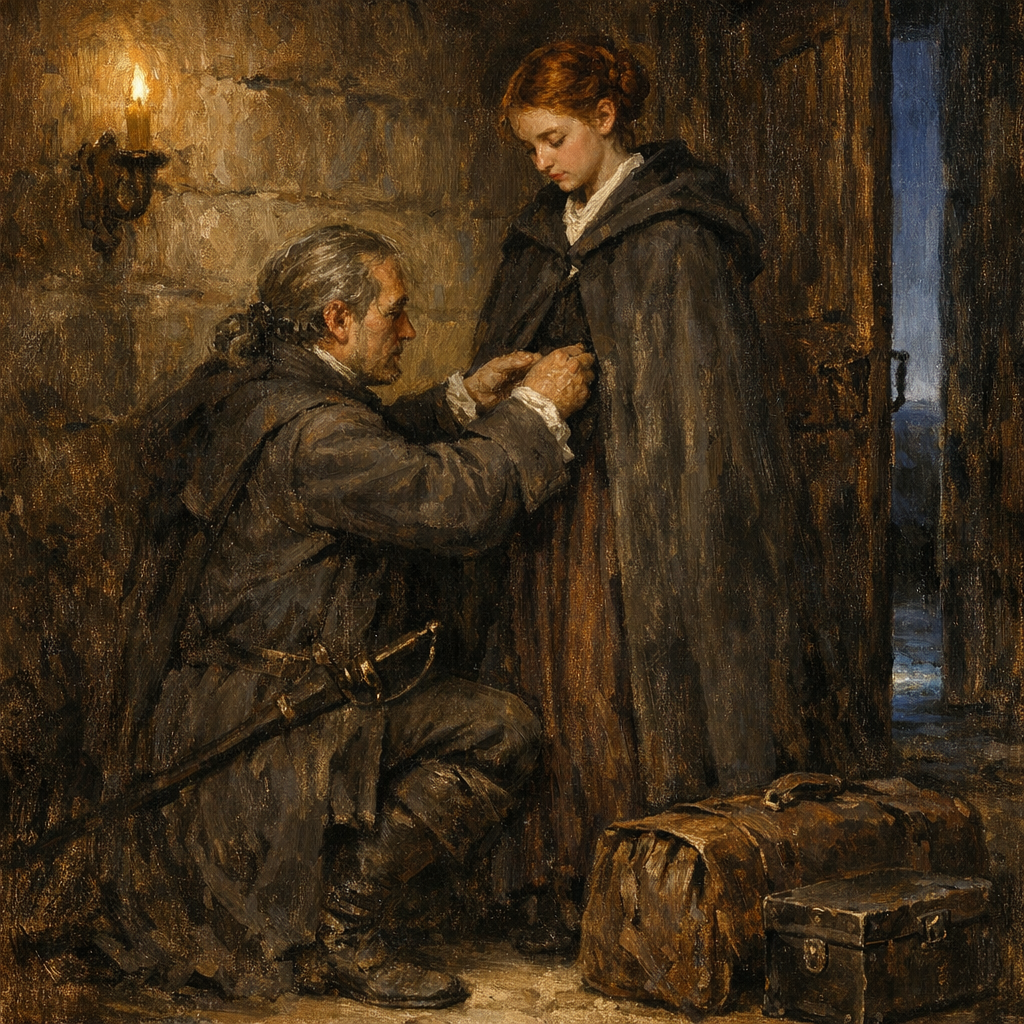
Pre-dawn, the Richis townhouse. A heavy wooden door part-open onto the indigo-cool pre-dawn outside. A single tallow candle in a wall sconce. A heavy travelling valise and a small leather strongbox of coin on the flagstones. Antoine Richis — no wig, salt-and-pepper hair tied in a simple queue, plain dark-grey wool travel coat over a plain wool waistcoat (the silks left behind), riding boots, a sword at his hip — kneeling beside Laure, fastening a heavy travelling cloak around her shoulders. Laure — sixteen, copper-red hair quickly braided and pinned, in a common-class dark wool kirtle, white linen fichu high at the throat, plain wool cloak, hood ready — standing still while her father fastens the cloak, eyes downcast, expression docile and trusting.
They take the back roads north through the Provençal mountains. Richis has chosen the disguise carefully: nothing visible to identify them as the family of the city's second consul. Just two travelers on the road. The chapter ends with them several hours into the night, Laure asleep against the carriage cushion, Richis at the window watching for pursuit that, by his reasoning, should not yet be possible.
Key moments
- The fastening of the cloak. A father's last competent gesture.
- The disguise. Common wool, no jewels, no silks. A magistrate translating panic into operational detail.
- The road north. Mountain roads, cold, stone underfoot.
Character shifts
Richis at full operational capacity — the most intelligent and capable he has been in the book. Laure trusting and quiet. The protagonist is offstage; the chapter belongs to the family.
Why it matters
The chapter is Süskind's careful demonstration that Richis has done everything a competent man could do with the resources of 1760. The book is preparing to demonstrate that everything a competent man could do, in this universe, is not enough.
Themes to notice
- Identity as something you have to make for yourself — and the unmade one Richis quickly assembles for his daughter to wear out of town.
- Pre-Revolutionary France as a body that knows it's rotting — including its road system. The mountain routes north of Grasse in 1760 are, as Süskind quietly notes, very poor cover.
Book club questions
- Richis chooses to flee north toward Grenoble rather than to the coast or to Paris. What is the prose telling you about his calculations?
- Süskind grants Laure no dialogue in the chapter. Is the silence a measure of her trust or of the prose's restraint?
Visual memory hook
A father in plain dark-grey wool kneeling at his daughter's feet in a pale-stone hallway lit by a single tallow candle, fastening a heavy travelling cloak around her shoulders, a heavy leather valise and a small strongbox at his side.
What's next
Chapter 44 stops them at La Napoule.