
Chapter 45
The chapter in one sentence
TL;DR: Grenouille slips into Laure Richis's guarded seclusion at the La Napoule inn at deepest night, kills her without a sound, and enfleurs her body with greased cloth — completing the keystone of his master perfume in absolute silence while Richis dozes a few feet away.
Spoilers through Chapter 45. The book's keystone murder, depicted in implication only.
The keystone harvest — the final note, the missing center, the entire reason for Part 3 — performed in silence, on a sleeping body, by a man who has waited fifteen years for the moment.
What happens
Süskind, as in chapter 37, refuses graphic depiction. The chapter renders the room afterward and the implements during with absolute clarity, and lets the act itself remain implicit between them.
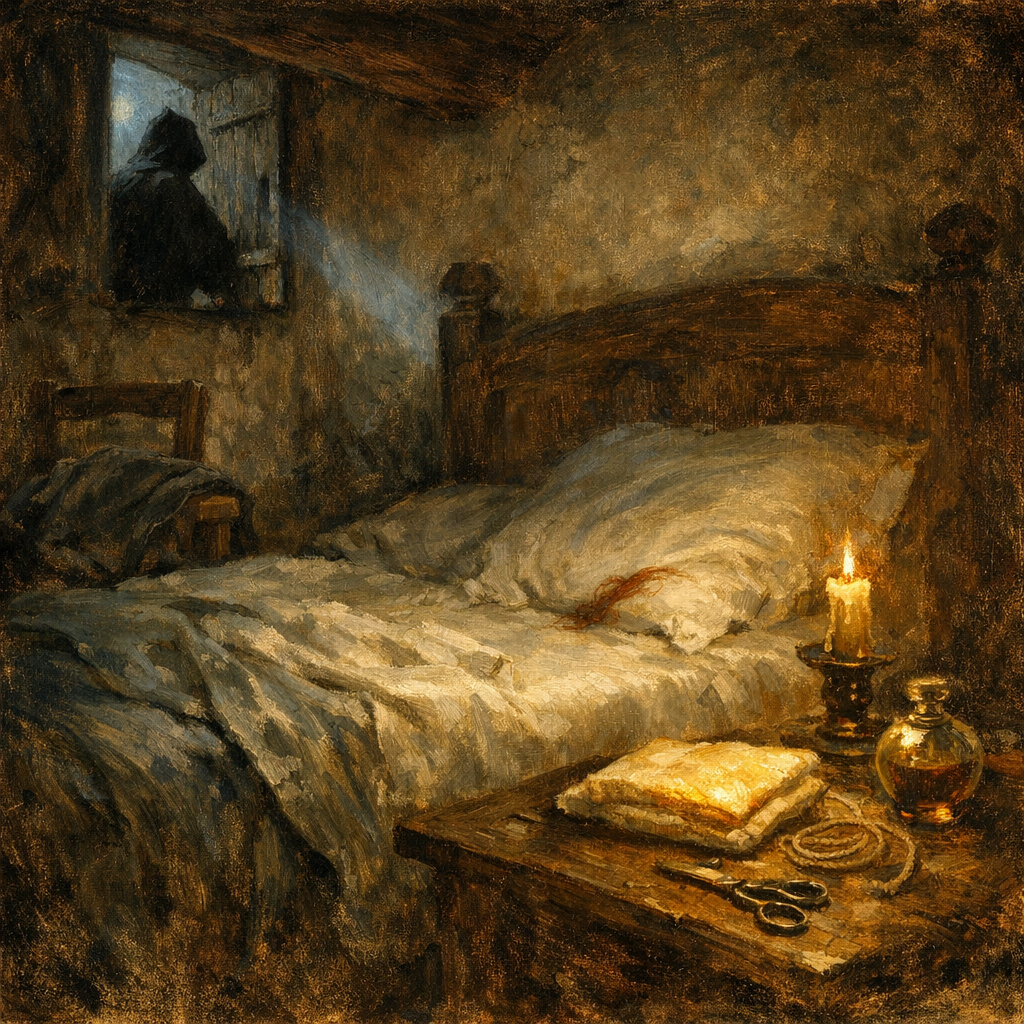
A small low-ceilinged inn bedroom at La Napoule, deepest night. The candle gutters. The shutters are unlatched. Grenouille enters through the window — a small hooded silhouette only — and the chapter holds its breath while he completes his work. The text gives us the materials, in the order they are used: the small steel pair of shears, the linen cord, the oil-soaked white linen square, the small unstoppered glass flacon. We are shown that the linen, when he leaves, glows faintly with a soft golden rectangle of captured scent — exactly as the cloth on the dry-stone wall in chapter 37 did.
Grenouille slips back through the shutter with the saturated linen in his hands. The composition is, in this chapter, structurally complete. He has the keystone. The perfume is finished.
Key moments
- The unlatched shutter. The threshold.
- The implements. Shears, cord, linen, flacon. The same kit as chapter 37, applied to the keystone.
- The glow. The folded linen, faintly luminous in the candle-stub. The book's signature image of completed harvest.
- The exit. Grenouille, prize in hand, gone.
Character shifts
Grenouille has, in this chapter, finished the perfume he has been making since chapter 9. The rest of the book is consequence. Laure is named for the last time as a living person.
Why it matters
The chapter is the structural climax of the book's procedural arc. Everything that has happened in Parts 1, 2, and 3 has been preparation for these few minutes in a small coastal inn. Süskind's choice to render the murder by implication — no body in frame, no blood, no struggle — is the book's most explicit moral instrument. The reader is shown only what an artisan would have packed and what an artisan would have produced.
Themes to notice
- The artist as monster, the monster as artist — fully consummated.
- Smell as the sense reason can't argue with — and as the only thing the chapter shows us was harvested.
- Worship as the most dangerous reflex — its operational ingredient now distilled in a small glass flacon in Grenouille's coat.
Book club questions
- Süskind refuses the graphic murder and shows us only the artisan's tools. Does the restraint feel ethical or evasive — and does the answer change between chapter 37 and chapter 45?
- The chapter completes the perfume. Did Süskind earn the literal completion — the click of the last note into place — or does the book's logic feel forced here?
- Antoine Richis sleeps a few feet away. The book gives him no waking, no premonition, no chance. What is Süskind's argument with that absence?
Visual memory hook
A small low-ceilinged inn bedroom at La Napoule with the bed empty in the candle-gutter — only an impression in the white linen, a single copper-red strand of hair caught on the pillow — and on the bedside table, a folded square of oil-soaked white linen still faintly glowing, the small glass flacon, the linen cord, the steel shears.
What's next
Chapter 46 is the morning.