
Chapter 51
The chapter in one sentence
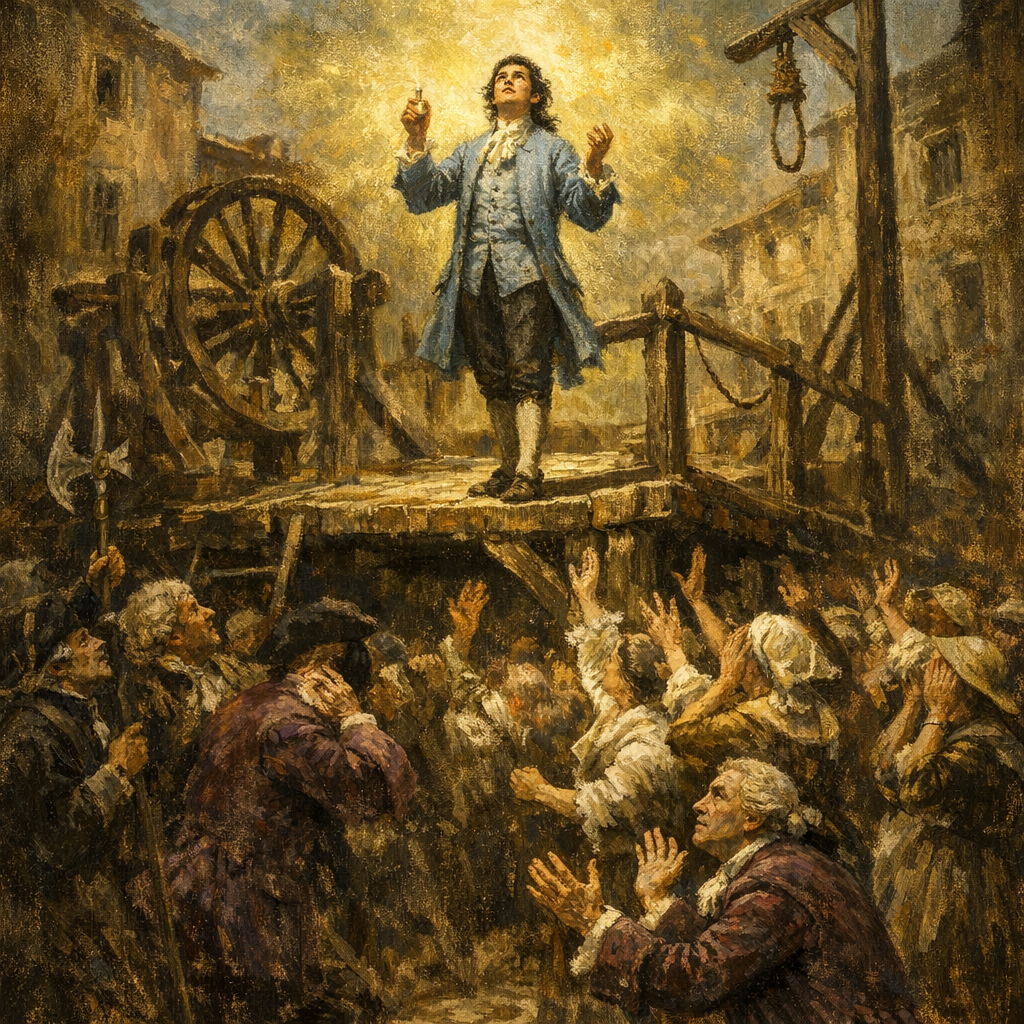
TL;DR: On the day of his execution Grenouille uncorks the master perfume on the scaffold and transforms a bloodthirsty crowd into a worshipful orgy that walks him out of Grasse alive — Druot is hanged in his place, Antoine Richis embraces him as a son, Grenouille walks back to Paris, and at the Cimetière des Innocents he pours the last of the perfume over himself so that a ring of vagabonds, drunk with love, devour him.
Spoilers through Chapter 51. The book's ending.
The most divisive ending in modern fiction — and, depending on which book-club you are in, either the book's most savage joke or its most exact moral logic.
What happens
The Place du Cours at midday. The wooden scaffold raised at center. The executioner's wheel and gibbet in plain view. The square packed — magistrates in plum coats, clergymen in white surplices, soldiers leaning on halberds, women in modest wool dresses and Provençal straw bonnets, a few children on shoulders. The dust-bright air suspended in a hush.
Grenouille — slight, dark, hair tied back, in clean light-blue silk — climbs to the platform and uncorks the tiny crystal vial. A faint visible thread of golden vapor rises from its mouth. The crowd in the immediate front of the scaffold begins to react. A magistrate sobs. A soldier drops his halberd. A woman reaches her arms upward as if toward an angel. The sob builds into a wave; the wave breaks; the entire square — judges, clergy, executioners, townspeople — collapses into a sprawling, delirious orgy beneath the scaffold. Antoine Richis, last of all, kneels at Grenouille's feet, weeping, and embraces him as a son.
Grenouille walks away. The town, when its delirium ebbs, refuses to admit it has just publicly pardoned the actual killer — and convicts and hangs Druot in his place. Grenouille walks north alone. Several hundred miles later he reaches Paris. He goes to the Cimetière des Innocents — the bone-yard he had loved as a boy in chapter 6 — and uncorks the last of the master perfume directly onto his own body. A ring of thieves, whores, and vagrants press in, kiss him, and in a frenzy of love tear him to pieces and consume him.
The book ends with the consumption. No coda. No narrator's gloss. Just the ring of mouths, and the absence of Grenouille from any place where any human being knew where he had gone.
Key moments
- The uncorked vial on the scaffold. A faint visible thread of golden vapor — the chapter's only "magical" image, and the book's last argument that scent is not magical at all.
- The crowd's collapse. A magistrate kneeling, a soldier dropping his halberd, a woman reaching upward. Süskind grants this as the physiological truth of what perfume can do.
- Antoine Richis embracing Grenouille. The book's most painful sentence, and its most exact.
- Druot hanged in his place. The town's silent post-hoc bookkeeping.
- The walk back to Paris. Grenouille's last solitary chapter.
- The Cimetière des Innocents. Süskind closes the geographic loop. The boy who loved this cemetery in chapter 6 returns to it at the end of his life.
- The consumption. The vagabonds tear him apart in love. The book ends.
Character shifts
Grenouille completes the project he began in chapter 9 and ends his life with it. Antoine Richis is the only character whose love the book has ever respected, and the chapter overwrites that love with smell in front of him. Druot is hanged. Madame Arnulfi survives the book.
Why it matters
The chapter is the book's structural argument distilled to its most explicit form. Worship runs on perfume; perfume runs on bodies; the species that produces both is unable to defend itself against its own most undefended sense; and the man who has manufactured the perfume cannot, in the end, become the self the perfume promises, because the perfume is not him. Grenouille dies as he was born — without a scent, seen finally and decisively only by a ring of mouths.
The chapter is also the book's final cruelty against the reader. Süskind has spent fifty chapters refusing to grant Grenouille moral redemption, and chapter 51 grants him worship instead, a different and worse mercy. The reader is left holding the difference.
Themes to notice
- The artist as monster, the monster as artist — the artist's masterpiece, performed.
- Worship as the most dangerous reflex — given its purest demonstration.
- Identity as something you have to make for yourself — and the limit of that project: the self Grenouille has assembled is a perfume, and a perfume cannot be the self of the man who made it.
- Pre-Revolutionary France as a body that knows it's rotting — closing the loop at the literal cemetery the historical city would have to close fifteen years later.
- Smell as the sense reason can't argue with — performed at industrial scale, at full volume, on a civic square.
Book club questions
- The execution-square inversion is one of the most divisive sentences in modern literary horror. Did Süskind earn it — or does it require a leap the previous fifty chapters do not actually finance?
- Should the book have ended at chapter 50?
- Antoine Richis embraces Grenouille as a son. What is the moral status of a love produced by chemistry — and is it the same as any other love?
- Druot's execution is reported in passing. Is the prose's lack of pause a structural argument about how towns dispose of inconvenient men, or simply an oversight?
- Grenouille's final death is the most savage joke in the book — the ring of vagabonds tear him apart in love. Is this his triumph (he is, finally, seen) or his defeat (the seeing is consumption)? Or is the book refusing the binary?
Visual memory hook
A small dark figure in clean light-blue silk on top of a wooden scaffold in a sun-struck civic square, a tiny uncorked crystal vial in his raised hand, a faint golden halo of vapor radiating outward across the dust-bright air, and a packed crowd below already beginning to drop to their knees.
What's next
Nothing — chapter 51 is the book.