
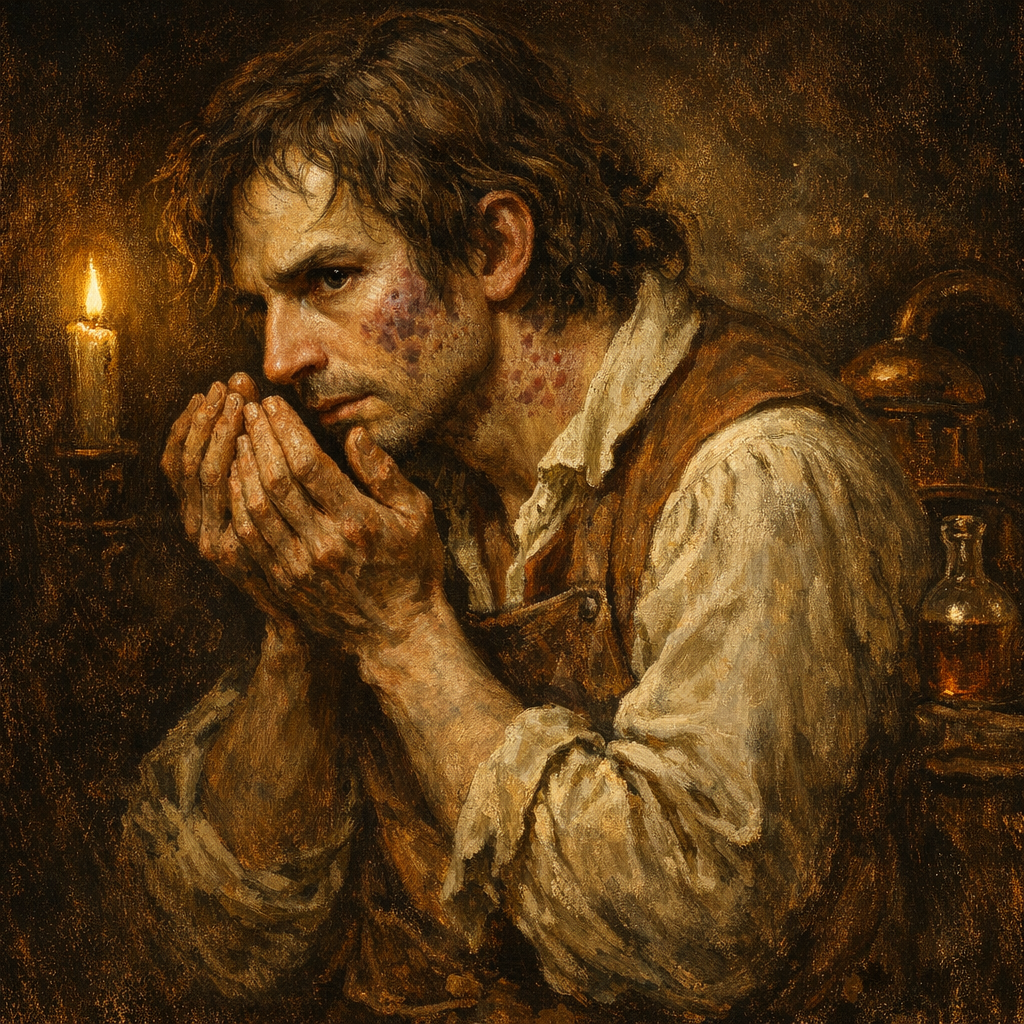
Jean Baptiste Grenouille
Jean-Baptiste Grenouille
TL;DR: A Paris-born outcast with the most acute sense of smell in human history and no scent of his own — Grenouille is the protagonist, the antihero, the artist, and the serial killer of Perfume, a man who murders twenty-five young women not from desire but to bottle their fragrance into a single masterpiece.
Spoiler-light. Includes Part 1 setup and the visual logic of his arc; final-chapter beats marked off.
Snapshot
A small, hunched, anthrax-scarred man with dark unkempt hair, sunken eyes, and a perpetually upraised nose. Speaks rarely. Watches everything through smell, and almost nothing through morality. The narrator calls him a tick — patient, hidden, capable of waiting years for a single drop.
Role in the story
Born July 17, 1738 beneath a fish stall in Paris to a mother who tried to abandon him and was hanged for it, Grenouille survives by the simple physical fact that his body refuses to die. He is rejected by wet nurses for being too greedy and too odorless, dismissed by a parish priest for the same reason, dropped at a children's home where the proprietress can't smell anything anyway, sold to a brutal tanner, and eventually apprenticed to an aging master perfumer on the Pont au Change.
The first half of the book is an apprenticeship in the literal sense. By the second half, Grenouille has retreated for seven years into a volcanic cave, discovered the truth about his missing scent, and walked south to the lavender hills of Grasse to take twenty-five young women apart for their fragrance — assembling, drop by drop, the perfume that gives the book its final chapter.
Grenouille never raises his voice. He never explains himself. He is the engine of every event in 263 pages, and Süskind grants him almost no interiority. You have to deduce him from his nose.
Personality in plain English
Grenouille is concentration. There is no warmth in him, no curiosity outside scent, no sexuality, no fear, no friendship. He is also not malicious in any of the usual ways — he doesn't hate his victims, he isn't jealous of his teachers, he doesn't want power. What he wants is technical: he wants to capture and fix a smell. His killing is closer to an artist's commission than to a predator's hunger, which is a great deal of why the book is so disturbing.
The narrator's recurring image — the tick that drops from a leaf onto a passing animal after years of patient waiting — is exact. Grenouille can wait seven years inside a cave. He can wait an entire spring while twenty-three other Grasse virgins die for him. The thing he is patient for is always the same thing.
What he wants
To create the perfect perfume. Specifically: to recreate, and surpass, the impossible scent he caught one summer night in Paris off a teenage plum-pitter — and to bottle it permanently, because scent is the one thing in the world that can be stolen and kept.
Underneath that, something stranger: he wants to be seen. He has lived since infancy as a man who registers as nothing — no smell, no presence — and his entire chemical project is, finally, an attempt to make himself perceivable. The horror of his arc is what people see when he succeeds.
What he fears (or hides)
Grenouille fears almost nothing visible. The only moment in the book where the narration suggests pure existential terror is the catastrophe in the cave — the night he discovers, in a dream, that he himself has no smell. He wakes up to the realization that he is, in his own register of reality, not there. The murders are downstream of that horror.
He hides his nose. From Baldini, from the Marquis, from Madame Arnulfi, from the magistrates, from everyone — Grenouille consistently passes for a slow, dim, simple journeyman, because if anyone understood what he could actually smell, he would be impossible to keep alive.
Key relationships
- Giuseppe Baldini — the perfumer who buys him from the tanner, teaches him the formal craft, profits enormously from him for one season, and drowns the night Grenouille leaves Paris. The book's clearest portrait of using the boy and being destroyed by it.
- The plum girl — the unnamed Paris teenager whose scent reveals to Grenouille that scent can be taken. The keystone he hunts for the rest of the book.
- Madame Gaillard — the children's-home keeper who couldn't smell him because she couldn't smell anything. The structural engine of his unobserved childhood.
- The Marquis de la Taillade-Espinasse — Montpellier dandy whose crackpot theory gives Grenouille the cover, the silks, and the access to perfume materials he needs to invent his first synthetic human odor.
- Druot — Madame Arnulfi's journeyman, who teaches Grenouille the cold-fat enfleurage technique and is hanged in his place at the end. The book's purest victim of the wrong man at the wrong moment.
- Laure Richis — the sixteen-year-old, copper-haired daughter of the Grasse second consul. The keystone scent. Grenouille's twenty-fifth and final harvest.
- Antoine Richis — Laure's father, the only character to deduce, without help, what Grenouille is doing. The most painful relationship in the book is the one that exists for thirty seconds at the foot of the scaffold.
Visual identity
Small. Hunched. One leg slightly shorter than the other, producing a faint limp. Dark unkempt hair, often longer than fashion. Sallow skin pebbled with anthrax-pit scars on one cheek and the side of the neck — souvenirs of his survived childhood illness in the tannery. Small, sunken, dark eyes that almost never meet another person's. Thin closed mouth. Bird-sharp features.
Costume tracks his life-stage with merciless precision: filthy linen smock and bare feet in the tannery; clean apprentice linen at Baldini's; almost-naked rags by the end of the cave hermitage; borrowed cream silk court coat at the Montpellier academy; plain leather perfumer's apron in Grasse; a clean blue silk coat for the scaffold.
His most characteristic gesture is hands cupped to the nose, eyes half-closed, head tilted back. In any image of him, the air is visible — a faint vapor, drifting petal-particles, dust motes catching candlelight. The world exhales and he receives.
Aliases
The following names and references in the book all point to this character. Use any of these as link anchors back to this page.
- Grenouille (canonical — the most common form)
- Jean-Baptiste Grenouille
- Jean-Baptiste
- The tick
Discussion questions
- Süskind tells you in the first paragraph that Grenouille is "one of the most gifted and abominable personages" of his era. Does giving you the verdict on page one make the rest of the book less moralistic — or more?
- The narrator returns to the metaphor of the tick. Is Grenouille a parasite, an insect, a saint, an artist, or some combination Süskind wants you not to be able to settle?
- Grenouille kills twenty-five young women without sexual contact. The murders are technical — fat-soaked cloth, shaved hair, harvested oil. How does the clinical register of the killings change what kind of horror this book is?
- Every adult who handles Grenouille is destroyed by him: his mother, Baldini, Grimal, the Marquis, Druot. Is the universe of Perfume punishing them for using him, or is Grenouille simply structural rot — a man who consumes everyone who touches him?
- The book gives Grenouille no interiority, but it gives him an obsession. Is the obsession enough to make him a character in the literary sense, or has Süskind written something stranger — a force in the shape of a man?
Full-book spoilers
Grenouille's last scene is the Cimetière des Innocents in Paris, where he uncorks the final dose of his master perfume and a ring of vagabonds — drunk on the scent — tear him apart and consume him in an act they experience as love. He dies with no scent of his own, finally and decisively seen, by people who eat him. Whether the ending is the book's most savage joke or its most exact moral logic is the perennial argument.