
Gwen
Gwen
TL;DR: Time-traveler, formerly a Leadchurch seamstress, currently in self-imposed exile in Atlantis. She arrives in book two with the agency book one finally revealed she had, sets the terms of any reconciliation with Martin, and ends the novel having earned a place in the climactic confrontation rather than being the prize at the end of it.
Spoiler level: full book. This page assumes you've finished Spell or High Water.
Snapshot
The reveal at the end of book one — that Gwen was a fellow reality-hacker who had been hiding her own powers and history — recast every scene she had been in. Book two is the book that lets her live in the open. She is not the love interest waiting in the wings; she is a woman in the middle of a hard decision about whether to forgive someone, and the novel takes her decision seriously.
Role in the story
Gwen left Leadchurch between books and went to Atlantis because it is a sanctuary explicitly designed for women time-travelers who have decided they want to be somewhere else for a while. She is established in the city by the time Martin and Phillip arrive; she has friends, she has a routine, she has her own reasons to be there.
Her arc has three movements. Distance: she has nothing to say to Martin when he first finds her, and the book lets that silence sit. Re-engagement: the assassination investigation puts her and Martin on the same team for entirely practical reasons, and the working partnership slowly thaws into something else. Reckoning: when Ida turns out to be a player in the conspiracy and a duel becomes inevitable, Gwen is the one who steps forward to face her. The book gives her the climactic Ida confrontation, not Martin, and the choice reads as a statement about whose city this is and who has standing to defend it.
Personality in plain English
Quiet, observant, dry. Gwen is not loud. She does not declare. She works things out by watching, and when she does speak it is usually because she has already decided. The book pays attention to how often, in any given group scene, she is the last person to speak — and the most likely to have the room's most considered take.
She is funny in a register that is harder to catch than Martin's running-commentary humor. Her jokes are slow, deadpan, and often only land a beat after the conversation has moved on. She does not perform warmth; the people who get her warmth get it without spectacle.
What she wants
To be allowed to make her own choices about what her life looks like, with or without Martin in it. To live somewhere her time-traveler status isn't an unsayable secret. To find out whether the man who showed up in Atlantis is someone she could trust with the second chance she hasn't yet decided to give.
What she fears
Being managed. Being a project. Being someone's growth opportunity. The version of Martin who showed up in Leadchurch in book one treated her as all three of those things without meaning to, and her exile is partly her response to that. The book makes clear she would rather be alone than be that again.
Key relationships
- Martin. The slow re-introduction. They start the book as people who used to know each other; they end it as people who might be starting over.
- Brit the Elder. Gwen has been in Atlantis long enough to have a working relationship with the Elder. The book is careful not to overplay the parallel between Gwen's exile and Brit the Younger's eventual departure, but the resonance is there.
- Ida. Antagonistic by the end. Gwen's duel with Ida is the book's most visually charged action beat and one of the few moments Gwen's full reality-hacker repertoire is on display.
- Phillip. Old colleague; she trusts him in a way she does not yet trust Martin again, and the book treats that as fair.
Visual identity
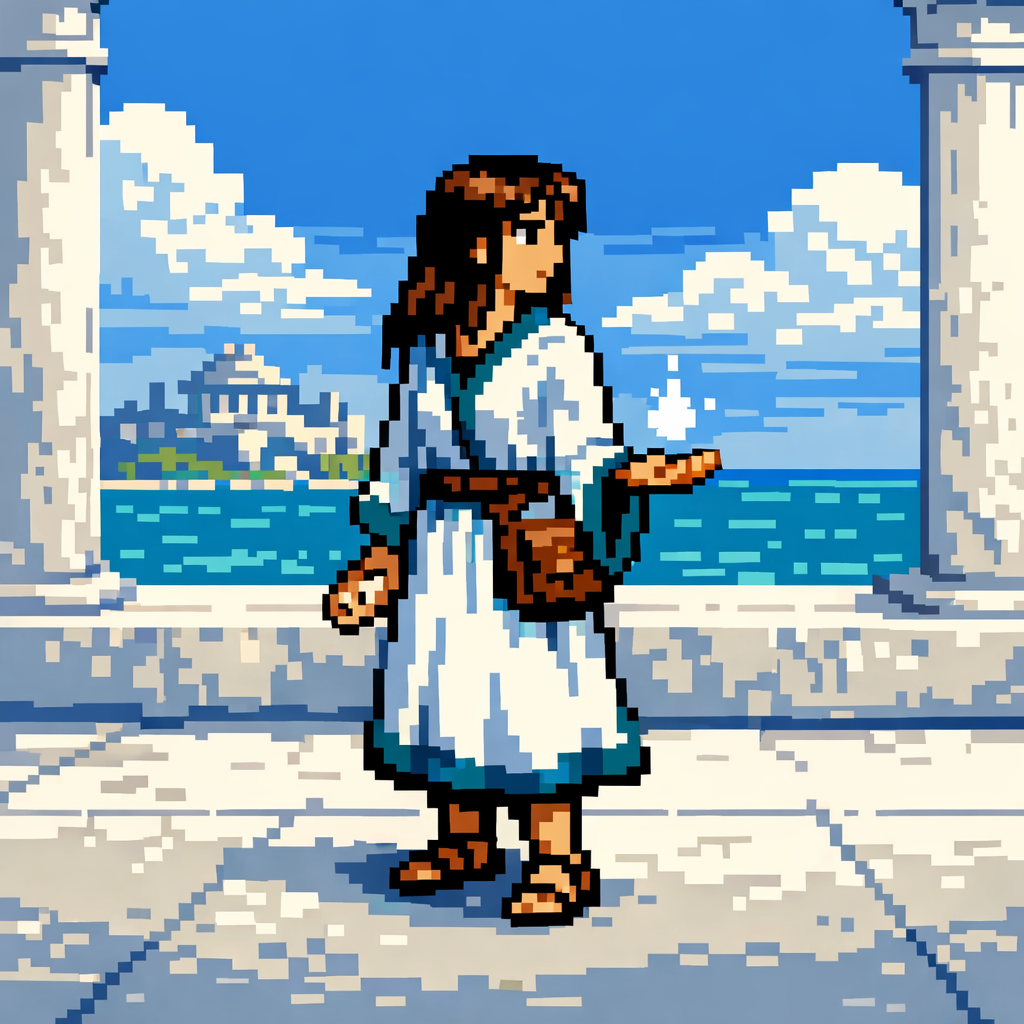
Adult woman, mid-20s apparent age, long dark-brown hair past her shoulders in a single block of color with a few highlight pixels. In Atlantis she has adopted the local style as a transitional outfit — a soft white robe with dark-teal trim along the sleeves and hem, plain leather sandals — but the underlying posture is still the practical, watchful one from her Leadchurch days. In flashback scenes she wears the muted blue-grey wool dress and cream apron of the Leadchurch seamstress, with a small leather pouch at her hip. When she casts in the climactic duel, the magic is precise and controlled — small geometric pulses of pale white light rather than showy bursts.
Aliases
The following names and references in the book all point to this character. Use any of these as link anchors back to this page.
- Gwen (canonical — the most common form)
Discussion questions
- Gwen's silence with Martin in chapter nine is the longest single emotional beat she gets in the book. Is the silence the book's gift to her, or a refusal to give her a full reaction?
- Atlantis is a sanctuary built for women like Gwen. Does the book persuade you that it's actually working, or does Gwen's quiet competence work despite the city rather than because of it?
- Gwen, not Martin, gets the climactic Ida confrontation. What is the book saying about whose fight that was?
- Compare Gwen's stillness with Brit the Younger's clipped intensity. Both are surviving managed lives; what does the book say about the different ways they cope?
- The book leaves Gwen and Martin in a state of "we might be starting over." Is that a romantic ending or a realistic one?