
Martin Banks
Also known as: Martin
Martin Banks
TL;DR: Reality-hacker turned credentialed wizard, a year older and a notch wiser than he was at the end of book one. Travels to Atlantis as Phillip's wingman, hoping to win back Gwen — and gets dragged into an assassination mystery, a Brit-on-Brit cold war, and the slow, awkward work of being a better partner.
Spoiler level: full book. This page assumes you've finished Spell or High Water.
Snapshot
The same everynerd from book one, with rust knocked off and confidence carefully rebuilt. Martin no longer treats reality as a buggy program he can fix from the command line; he treats it as a place he has to live in, with people whose feelings he has actual responsibility for. The dry self-deprecation is still the dominant register, but it now has the warmth of someone who has learned what it costs to be the joke.
Role in the story
Martin is the protagonist and viewpoint character for the Atlantis plotline. He's pulled out of Leadchurch routine in chapter four when Phillip is summoned to the time-traveler summit and chooses to bring Martin along. From the moment he reaches the city, he is doing three things in parallel: trying to repair things with Gwen, backing Phillip on the diplomatic stuff, and — once the "accidents" start — quietly investigating what's actually going on. He is the one who finally connects the conspiracy back to Ida's inner circle, and he ends up in the climactic plaza brawl alongside Ampyx, the Atlantean guard who has been awkwardly trying to copy his look the whole book.
His arc is the second-act-of-a-redemption-arc that book one set up. Where book-one Martin was learning what not to do with the file, book-two Martin is learning what to do with himself once the temptations are off the table. The plot keeps testing him with chances to take the easy way out — a cleaner edit, a faster fix, a more flattering lie — and his growth is measured in the moments he turns them down.
Personality in plain English
Same brain as before — funny, jittery, fast at the keyboard, slow at the throat-clearing moments. What's different is calibration. He's still the kind of guy who will reach for a joke to defuse a heavy moment, but he no longer reaches for it before letting the moment land. He listens more. He flinches less. He owns his book-one mistakes without making them everyone else's problem, which is itself a kind of magic.
His worst habit in book two is the same one he had in book one — wanting to fix things faster than they want to be fixed — but the book is consistent in showing him notice this and back off. His best is that he has finally figured out that Phillip is not just a mentor but a friend, and treats him accordingly.
What he wants
Gwen back, but on terms that don't require him to lie to himself or her. To be useful — to Phillip, to the investigation, to the people of Atlantis who weren't asking to be assassinated. To prove, mostly to himself, that the credentialed-wizard title he wears is more than a costume.
What he fears
That he's already too late with Gwen. That he's still the guy he was in book one and just got better at hiding it. That his instincts under pressure — the reach for the file, the macro-first reflex — will get someone hurt who didn't have to be.
Key relationships
- Phillip. Mentor and travel partner. Their bickering is the comedic spine of the book and their loyalty under fire is its emotional spine.
- Gwen. The reason Martin agrees to come to Atlantis in the first place. Their reconciliation is slow, real, and entirely about Martin doing things right that he did wrong the first time.
- Brit the Younger. They aren't friends, exactly, but they end up trusting each other under fire. Martin sees a version of himself in her — someone trying not to be steered by a predetermined future.
- Ampyx. The Atlantean guard who has decided Martin is the model to copy. Inadvertently hilarious, eventually a real ally in the plaza brawl.
- Jimmy. Mostly off-screen for Martin in this book, but Jimmy's redemption arc is happening in parallel and casts a long shadow. Martin's choices read differently when you remember who he used to be afraid of becoming.
Visual identity
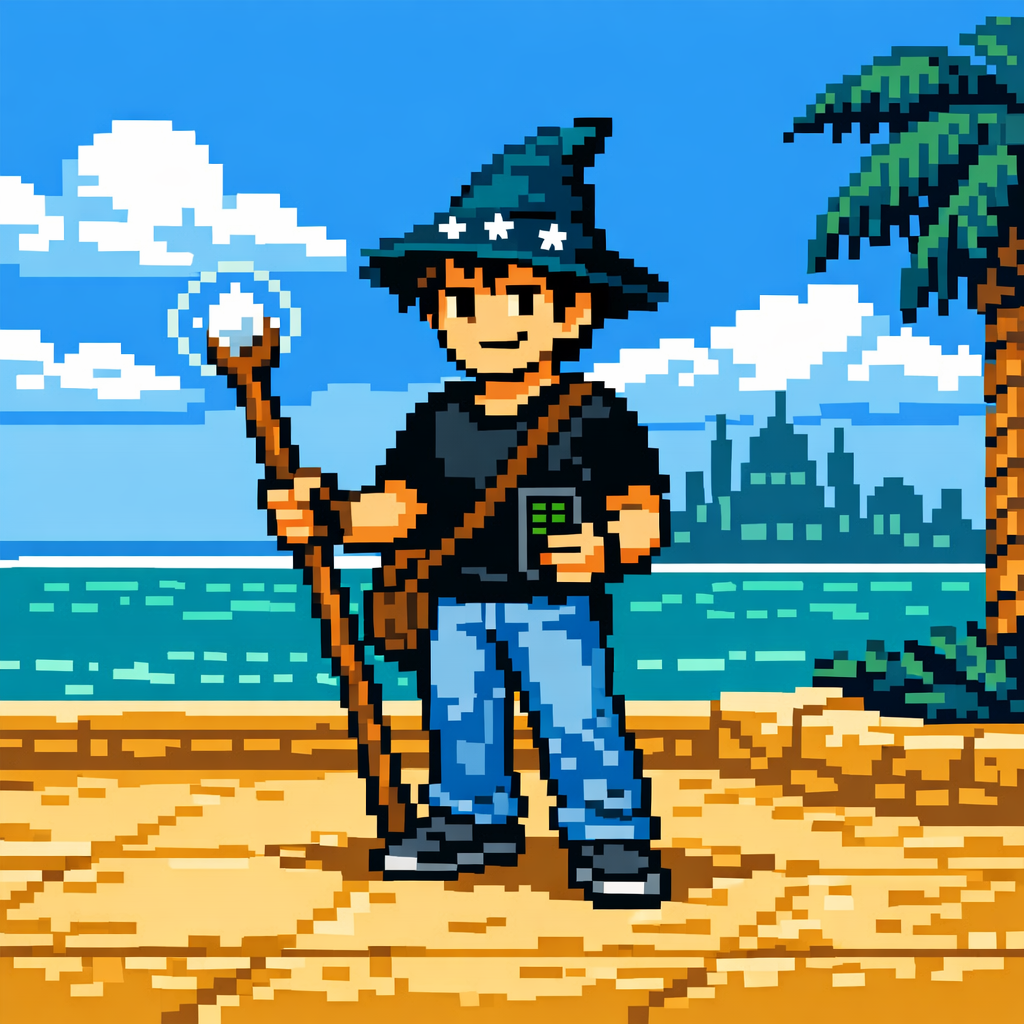
The right-hand figure on the cover. Dark teal striped conical wizard hat with three small white stars on the brim — same as book one, his signature. Plain black modern t-shirt under the hat, light-blue jeans, dark sneakers, a brown leather satchel slung at the hip. He carries a brown wooden staff with a single glowing white pixel orb at the tip, the same one Phillip helped him commission. In Atlantean scenes the outfit reads as a deliberate refusal to assimilate — everyone around him is in togas and robes, and he's still in the t-shirt he came in. When he casts, the gag is the same as book one: medieval setting on the outside, terminal-green code-glyphs on the screen of whatever phone or scroll he's actually using.
Aliases
The following names and references in the book all point to this character. Use any of these as link anchors back to this page.
- Martin (canonical — the most common form)
- Martin Banks
- Martin Kenneth Banks
- Banks
Discussion questions
- Book-two Martin owns his book-one mistakes without becoming insufferable about them. How does the book pull that off, and when does it almost fail?
- Martin chooses to come to Atlantis primarily for Gwen. Phillip needs him there for the work. Which of those two reasons does the book end up endorsing — and is there a version where it's both?
- Ampyx spends the book trying to be Martin. Martin spends the book trying not to be book-one Martin. What does the book think about the project of trying to be a better version of yourself by copying someone else?
- The climactic plaza brawl is the first real action set-piece Martin handles competently. Is the book treating that as a milestone, a punchline, or both?
- By the end of book two, has Martin earned Gwen back — or has he just earned the chance to keep trying?