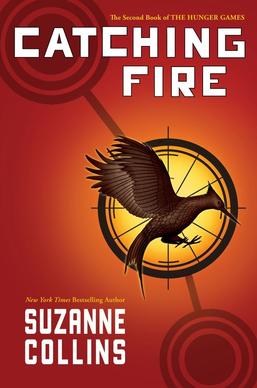
Catching Fire
Suzanne Collins
Browse chapters below. Sign in anytime to save your reading progress.
Chapters
Save progress and unlock more with a free account
Resume links, your reading list, reactions, and progress-earned unlocks all show up once you sign in.
Dive deeper into the book
Themes stay spoiler-safe until the end
Create a free account to save progress so themes can unlock right when you finish the book.
About this book
Spoiler-light.
TL;DR: The middle book of the Hunger Games trilogy turns a survival story into the story of a nation about to catch fire — Katniss is alive, famous, and more trapped than ever, and the spark she lit refuses to go out.
The book in one paragraph
Katniss Everdeen survived the arena, but winning solved nothing. Months later she is living in Victor's Village, wealthy and watched, when President Snow appears in her home with a quiet ultimatum: the stunt that saved her life looked like rebellion to the watching districts, and unless she can convince all of Panem on the coming Victory Tour that it was only a lovestruck girl's recklessness, everyone she loves will pay. But the tour only spreads the spark — unrest stirs district by district while District 12 falls under a brutal new regime. And then the Capitol announces the Quarter Quell, a once-in-a-generation edition of the Games with a twist engineered to pull Katniss back toward the arena she barely escaped. Catching Fire is the rare middle book that raises every stake at once.
Why readers gather around this book
Catching Fire is the book where the Hunger Games series stops being a survival story and becomes a story about revolution — and it does it without losing an ounce of momentum. It gives a book club two things to argue about at once: the slow-burn political thriller of a country tipping toward open revolt, and the intimate question of who Katniss actually is when she's no longer fighting for her life but for a cause she never chose. It is widely considered the strongest book in the trilogy, and it ends on one of YA's most talked-about final pages.
What to know before reading
- Reading experience: Fast, tense, and propulsive — the same tight first-person, present-tense narration as Book One, with an even harder grip in its second half.
- Genre / mood: Young-adult dystopian science fiction; a political thriller in its first half, a survival thriller in its second.
- Read Book One first: This is the middle volume of a trilogy. Start with The Hunger Games — Catching Fire assumes you know how Katniss's first Games ended.
- Content notes: Life-or-death peril, public violence and punishment, and the deaths of characters, handled seriously rather than gratuitously.
- Best for: Readers who loved Book One and want the world to widen — more of Panem, higher political stakes, and a story that grows darker and more morally complicated.
Main characters
Spoiler-safe sketches.
- Katniss Everdeen — The series' narrator: a victor of the last Games, now an unwilling symbol the Capitol wants silenced and the districts want to follow.
- Peeta Mellark — The baker's son who survived the arena beside her; steady, eloquent, and still tangled in a love story that may or may not be real.
- Gale Hawthorne — Katniss's closest friend from home, angrier at the Capitol than ever and harder to keep safe.
- Haymitch Abernathy — District 12's veteran victor and mentor, playing a longer game than he lets on.
- President Coriolanus Snow — Panem's cold, patient ruler, who has made Katniss's survival his personal problem.
- Effie Trinket — The Capitol escort whose bright manners are beginning to strain against what she's part of.
- Cinna — Katniss's quietly daring stylist, who turns fashion into a form of protest.
- Finnick Odair — A charismatic, unreadable victor from District 4 whom Katniss meets along the way.
How the book is shaped
The novel runs 27 chapters in three nine-chapter parts — The Spark, The Quell, and The Enemy — a clean three-act build that moves from the Victory Tour, through a tightening political vise, to a final act that changes the series for good. It is told entirely in Katniss's first-person, present-tense voice, and its chapters end on hard hooks; most readers find the back half nearly impossible to put down.
Chapter guide
A chapter-by-chapter companion is available in the chapters section — TL;DRs, key moments, and discussion questions for all 27 chapters, each labeled with its spoiler level so you can read along without getting ahead of yourself.
Major themes
The full themes guide covers the threads that run through the book: surveillance and performance, how rebellion spreads, the cost of being made into a symbol, and loyalty under impossible pressure. See the themes page for the deep dive.
Best discussion angles
- Snow tells Katniss her defiance must be read as love, not rebellion. Can a public act ever be controlled by the person who performed it?
- Catching Fire is a middle book that's often called the best in the trilogy. What does it do that first and last books usually can't?
- Katniss spends the novel being managed — by Snow, by Haymitch, by the Capitol's cameras. How much agency does she actually have, and when?
- The book keeps showing ordinary people taking small risks: a whistle, a salute, a shared meal. How does it argue that revolutions are built?
- The final chapter is one of the most discussed endings in YA. Did it feel earned — and how does it change your reading of everything before it?
Where to read it
Buy / borrow / listen links — to be filled in by the site.
Want a printable book-club kit?
Printable discussion cards, character portraits, and chapter cover art — coming soon. </content>