
Chapter 16
The chapter in one sentence
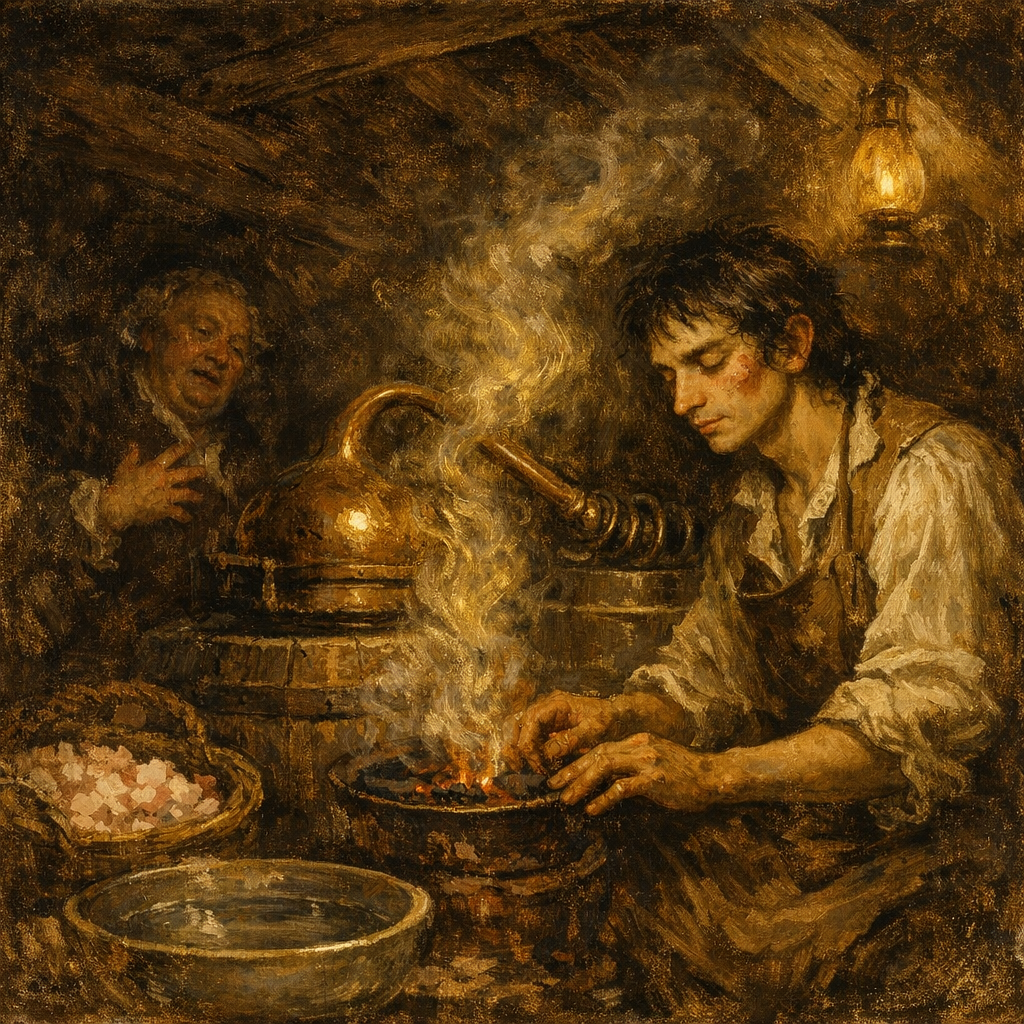
TL;DR: In Baldini's candlelit attic stillroom, Grenouille watches the master perform a single demonstration of distilling flowers and is then permitted to run the alembic himself, producing an essence so pure it humiliates Baldini and shifts the moral economy of the workshop forever.
Spoilers through Chapter 16.
The lecture moves from the worktable to the still, and Baldini stops being a teacher.
What happens
Baldini, gloved, aproned, theatrical, performs a flower distillation in the cramped attic stillroom of the Pont au Change shop. Crushed petals, distilled water, charcoal under a copper alembic, condenser tube, a slow patient drip. He narrates each step. Grenouille watches, motionless. When the demonstration is done Baldini, indulging the boy, lets him try.
Grenouille runs the alembic in silence. The essence that drips into the receiving flask is denser, purer, more concentrated than anything Baldini has ever produced. Baldini, leaning over the catch-flask, registers in two breaths what the next eight chapters will simply confirm: he is no longer the better perfumer in this attic; he was probably never going to be again the moment Grenouille walked through his door.
Key moments
- The brazier. Süskind takes time on the small physical apparatus — bellows, charcoal, condenser tubing — because the materiality of the trade is part of the chapter's pleasure.
- The single demonstration. Baldini gets one chance to teach the technique. Grenouille only ever needs one.
- The drop. A first golden droplet falls from the condenser into the catch-flask. Baldini smells it. The chapter's whole argument is in his face.
Character shifts
Baldini moves from theatrical instructor to spectator of his own apprentice. He cannot quite say so out loud, but the prose makes the demotion explicit. Grenouille acquires the only piece of formal craft he actually needed — the technique of distillation — and from this point will run circles around any flower he is given.
Why it matters
The chapter is the moment the workshop's commercial logic flips. From here forward Grenouille is the production engine; Baldini is the brand. The next several chapters will be a montage of the shop's success. The chapter is also a quiet argument about what teaching is: Baldini's instruction is, in the end, technical disclosure; the talent that uses the disclosure is its own thing.
Themes to notice
- The artist as monster — given a workshop and a copper alembic.
- Smell as the sense reason can't argue with — converted now into chemistry.
Book club questions
- Süskind grants Grenouille the technique on a single demonstration. Is the absence of practice realistic — and if not, what is the book trying to argue by skipping it?
- Baldini cannot quite admit, even to himself, that his apprentice has surpassed him. What does the prose let him hide from, and what does it not?
Visual memory hook
A copper alembic on a low brick brazier, steam curling up the condenser tube, golden essence dripping into a glass receiver — and a small dark hunched figure at the still, eyes half-closed, while his master watches from the deeper shadow.
What's next
Chapter 17 lets the shop's new economy run for a season.