
Chapter 17
The chapter in one sentence
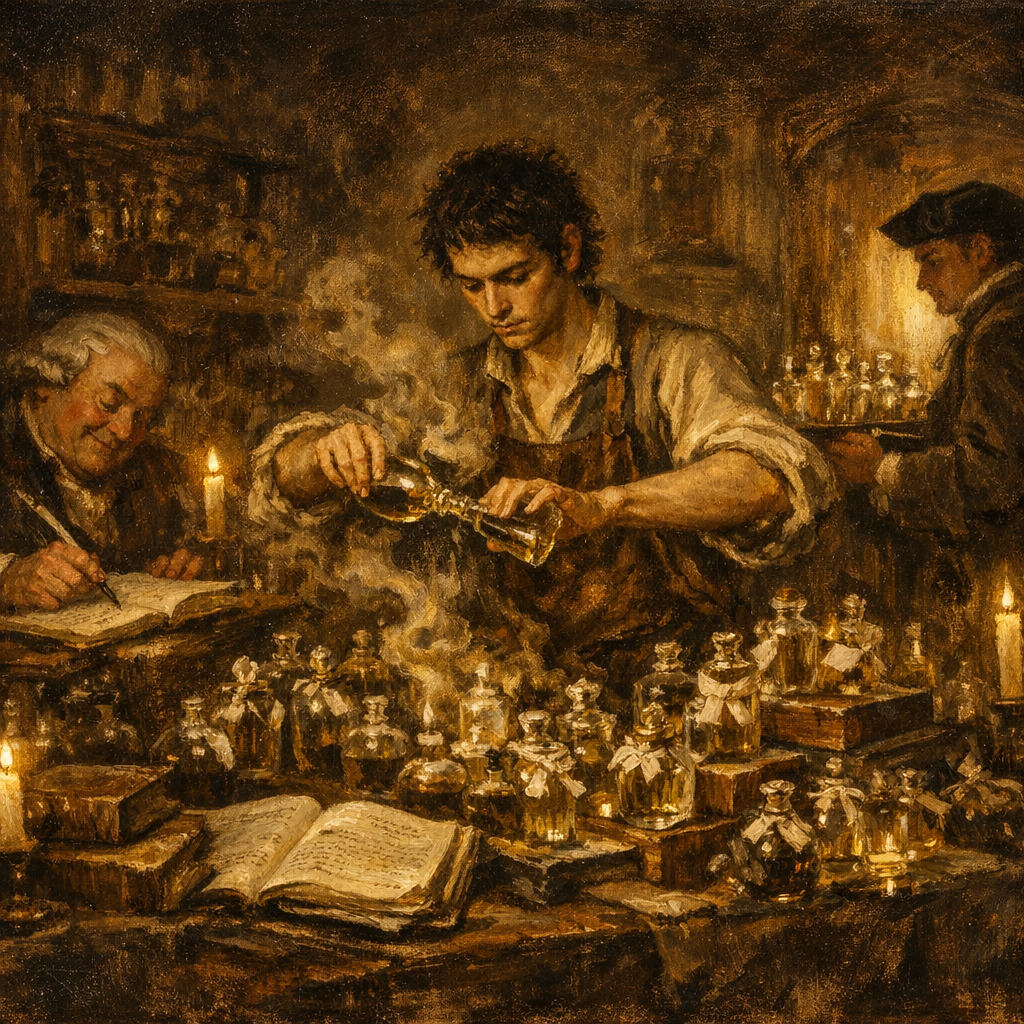
TL;DR: Hidden in Baldini's back room, Grenouille pours out new perfumes at supernatural pace while Baldini dictates names and writes formulas into the recipe ledger — and the dim, fading bridge-side boutique becomes, for a single season, the most fashionable address in Paris.
Spoilers through Chapter 17.
A montage chapter — the workshop's golden season, every bottle a Grenouille, every label a Baldini, every fashionable Parisian noble at the door.
What happens
Süskind compresses several months. The back room of Baldini's shop runs on production lines: Grenouille at the work-counter improvising blends, Baldini at the desk transcribing the recipes into a thick formulary and assigning grand names — Nuit de Naples, Amour de l'Aurore, etc. Chénier carries finished bottles to the front. Society women carry them home. The Pont au Change has not seen this kind of foot traffic in a decade.
The chapter is delighted with itself. The rhythm of production — petal, alembic, blend, label, sale, repeat — is rendered as a small, breathless industry. Baldini's anxieties about Pélissier disappear. He is rich; he is fashionable again; he sleeps badly because he knows none of this is his.
Key moments
- The candelabrum. Multiple candles producing overlapping warm-gold pools of light over the worktable — the visual signature of Grenouille's most productive period.
- The recipe ledger. Baldini writing furiously, ink-stained, half-trying to understand what Grenouille is doing and half-content not to.
- The customers. The book gestures at, but does not name, the fashionable Parisians whose houses are now perfumed by an unknown tannery boy.
Character shifts
Grenouille is at the height of his Paris productivity. Baldini is at the height of his commercial success and, beneath it, his accumulating dread. The shop will not stay this profitable; the boy is, the prose hints, restless.
Why it matters
The chapter is one of the book's two great pleasure-pieces about making (the other will be the cave's interior scent palace in chapter 27). It is also the calm before Grenouille's first serious illness in chapter 18, which forces Baldini to confront the fragility of his entire arrangement.
Themes to notice
- The artist as monster, the monster as artist — generating commerce.
- Worship as the most dangerous reflex — its commercial form: fashionable Paris is, in this chapter, falling for a boy it does not know exists.
Book club questions
- Süskind grants the shop a montage of success. Does the prose let you enjoy it, or undercut the pleasure as it goes?
- Baldini knows he is taking credit for a labor that isn't his. What kind of moral failure is that — and where would you rank it among the book's other adult complicities?
Visual memory hook
A candlelit back room with a wooden worktable buried under stacked finished glass perfume flacons, a small dark figure at the center pouring from one flacon into another in a single fluid motion, drifts of golden vapor rising from a dozen open bottles.
What's next
Chapter 18 reminds Baldini what his fortune actually depends on.