
Chapter 37
The chapter in one sentence
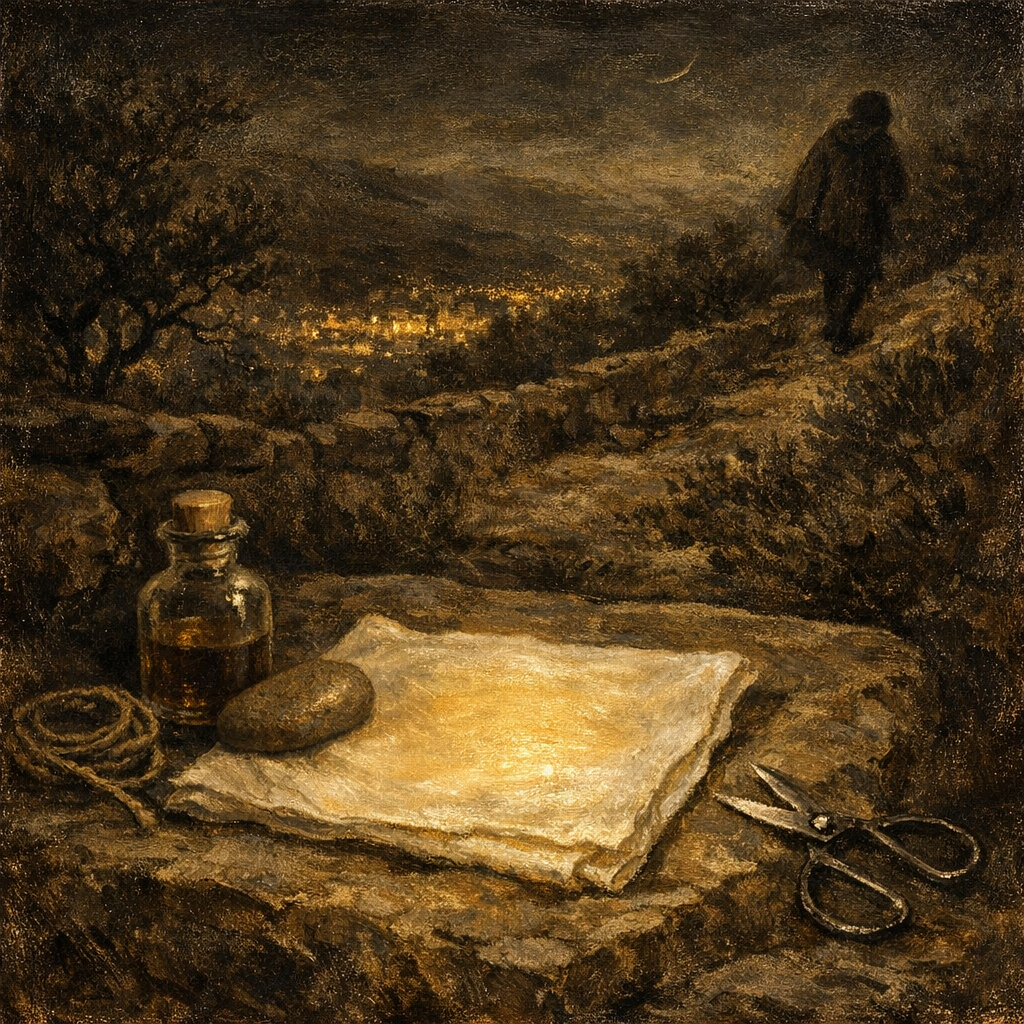
TL;DR: On a breathless moonless night above the lavender terraces of Grasse, Grenouille kills a young woman in the lee of a dry-stone wall and enfleurs her body with fat-soaked linen to harvest her scent — the first of the Grasse murders, the procedural turn of Part 3, performed in absolute silence and rendered by Süskind with deliberate restraint.
Spoilers through Chapter 37. The first Grasse murder.
The book performs the first Grasse killing in implication rather than depiction, and the choice of restraint is itself the chapter's argument.
What happens
Süskind does not give us the killing on the page. He gives us the preparation — Grenouille on a terraced hillside above Grasse, the lee of a dry-stone wall, the moonless or thinnest-moon sky, the air still and dry and scented with crushed thyme. He gives us the aftermath — a single oil-soaked square of folded white linen laid out on a flat stone, weighted at one corner with a smooth river-pebble, glowing faintly as if it has just received a luminous scent. A small unlabeled glass flacon stoppered with a wooden cork. A folded length of cord. A small steel pair of shears.
The body is not on the page. The girl is not named. Süskind's clinical restraint is total. The reader is shown the materials of a murder, in the order they would have been used; the act is implicit between the materials.
The chapter ends with Grenouille slipping back down the terraces, the small cloth-and-flacon kit in his hands, the procedure proven, the campaign begun.
Key moments
- The terrace. Dry-stone walls, lavender, the lee where he waits.
- The implements. Oiled linen, glass flacon, cord, shears. Süskind names each.
- The glow. A faint golden rectangle on the stone — the visible trace of the scent the linen has just absorbed.
- The descent. Grenouille walking back down to the workshop, prize in hand.
Character shifts
Grenouille completes the inferential leap of chapter 36. The Grasse campaign begins. Süskind grants the protagonist no remorse, no pleasure, no triumph — only competence.
Why it matters
The chapter installs the moral and procedural logic the next dozen chapters will repeat. The book is not going to give us twenty-five graphic murders. It is going to give us twenty-five empty cloths, twenty-five disappearances, twenty-five small Grasse households waking to news. Süskind's argument here is that the absence of graphic detail is more disturbing than its presence would be.
Themes to notice
- The artist as monster, the monster as artist — the artist's first proof of concept.
- Smell as the sense reason can't argue with — and as the only thing the chapter shows us was harvested.
Book club questions
- Süskind refuses to depict the murder. Does the restraint feel ethical, evasive, or both?
- The chapter is composed of the materials of a murder rather than the act. What does this teach you about how Süskind has been using objects throughout the book?
Visual memory hook
A flat stone in the lee of a dry-stone wall on a moonless terraced Grasse hillside — and on it, a single oil-soaked square of folded white linen weighted by a small river pebble, faintly glowing.
What's next
Chapter 38 lets the town react.