
Chapter 38
The chapter in one sentence
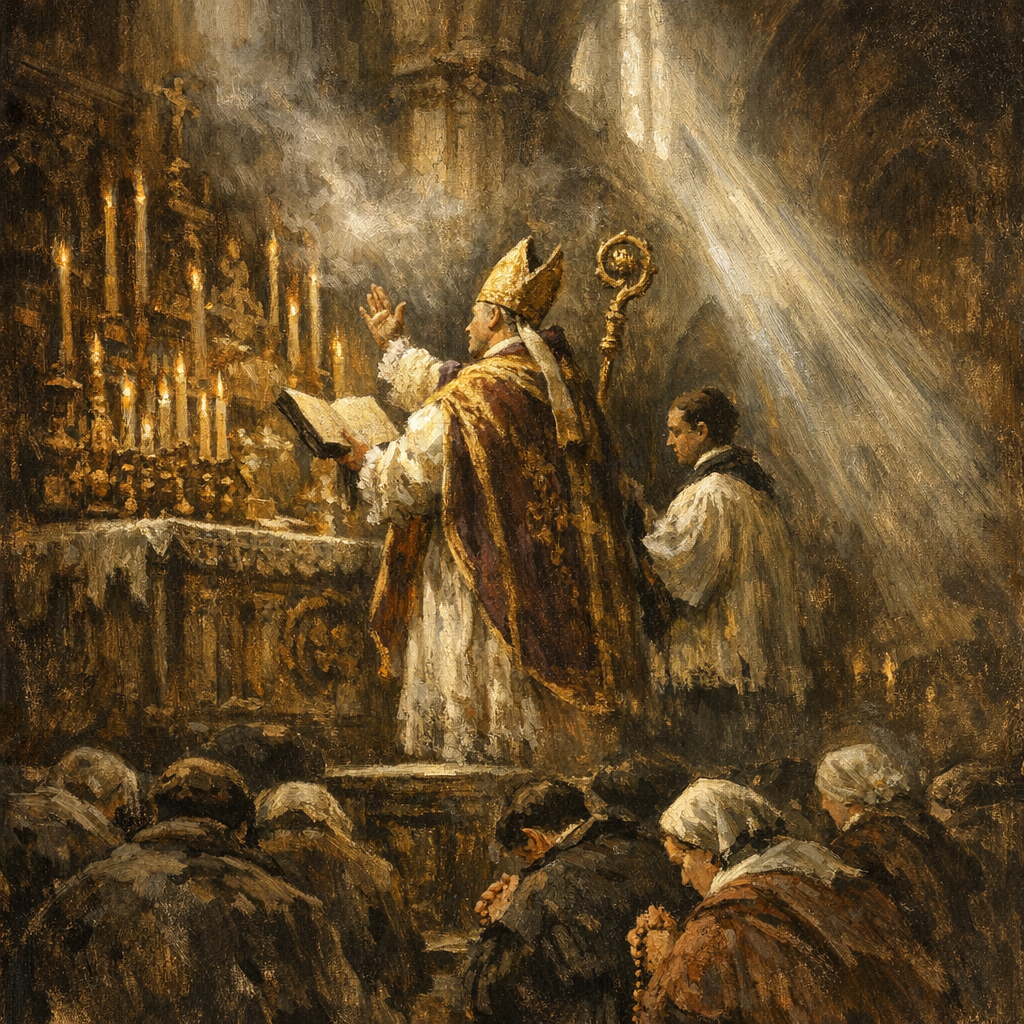
TL;DR: Grasse shutters itself as the Bishop publicly excommunicates the unknown killer in a bell-tolling, incense-veiled cathedral ceremony — and the prose makes very clear that incense and edicts are not going to thin the panic in the flower-scented Grasse air.
Spoilers through Chapter 38.
The Catholic establishment performs its own ritual against Grenouille and the prose, polite but unmistakable, registers that the ritual will not work.
What happens
The high nave of the Cathedral of Notre-Dame du Puy, day. Stone vaulting receding into deep umber. Banks of beeswax candles at the altar. A thick veil of frankincense. Clusters of townspeople kneeling in pews, heads bowed, rosaries clutched, wool cloaks and modest Provençal Sunday dress. The Bishop in heavy gold-embroidered mitre and white-and-purple chasuble at the altar pronouncing excommunication on the unknown murderer; an acolyte holding an open missal; bells tolling.
Grasse leaves the cathedral spiritually adjusted and physically unprotected. The campaign continues that very night. The Bishop's vocabulary has produced an effect on the air of the cathedral — incense, prayer, fear — but no effect on the man who is going to walk through the streets again as soon as the next moonless night arrives.
Key moments
- The high nave. Stone vaulting, slanted daylight columns, hushed congregation.
- The Bishop's pronouncement. Ringed hand raised; voice frozen mid-incantation.
- The walk home. Grasse leaves with rosaries and wool cloaks and the same vulnerabilities they walked in with.
Character shifts
Grasse acquires a public posture toward the murders — fear, prayer, edict. The book lets the posture be earnest and useless at the same time.
Why it matters
The chapter is Süskind's quiet argument that the Catholic infrastructure of pre-Revolutionary France is, by 1760, performing rather than functioning. The Bishop's vocabulary is correct — he names a moral evil — and entirely impotent. The next chapters will make clear that what works against Grenouille is not religious but forensic: it takes Antoine Richis, a private secular intelligence with a map and a quill, to do what the bishop's excommunication cannot.
Themes to notice
- Worship as the most dangerous reflex — its public form: a town worshipping at God against a man who is not, in any register the worship can reach, present.
- Pre-Revolutionary France as a body that knows it's rotting — the church as one of the failing organs.
Book club questions
- The bishop is given no name in the book. What does that tell you about how Süskind ranks the church's role in this story?
- Excommunication is, in 1760, still a serious civic act. Does the chapter want you to feel its seriousness, or its absurdity, or both?
Visual memory hook
The high nave of a Provençal cathedral filled with kneeling townspeople, a Bishop in white-and-purple chasuble at the altar with a ringed hand raised mid-incantation, slanted columns of daylight cutting the air diagonally through banks of beeswax candles and a thick veil of frankincense.
What's next
Chapter 39 returns to the workshop and lets Grenouille perfect his disguise.