
Chapter 48
The chapter in one sentence
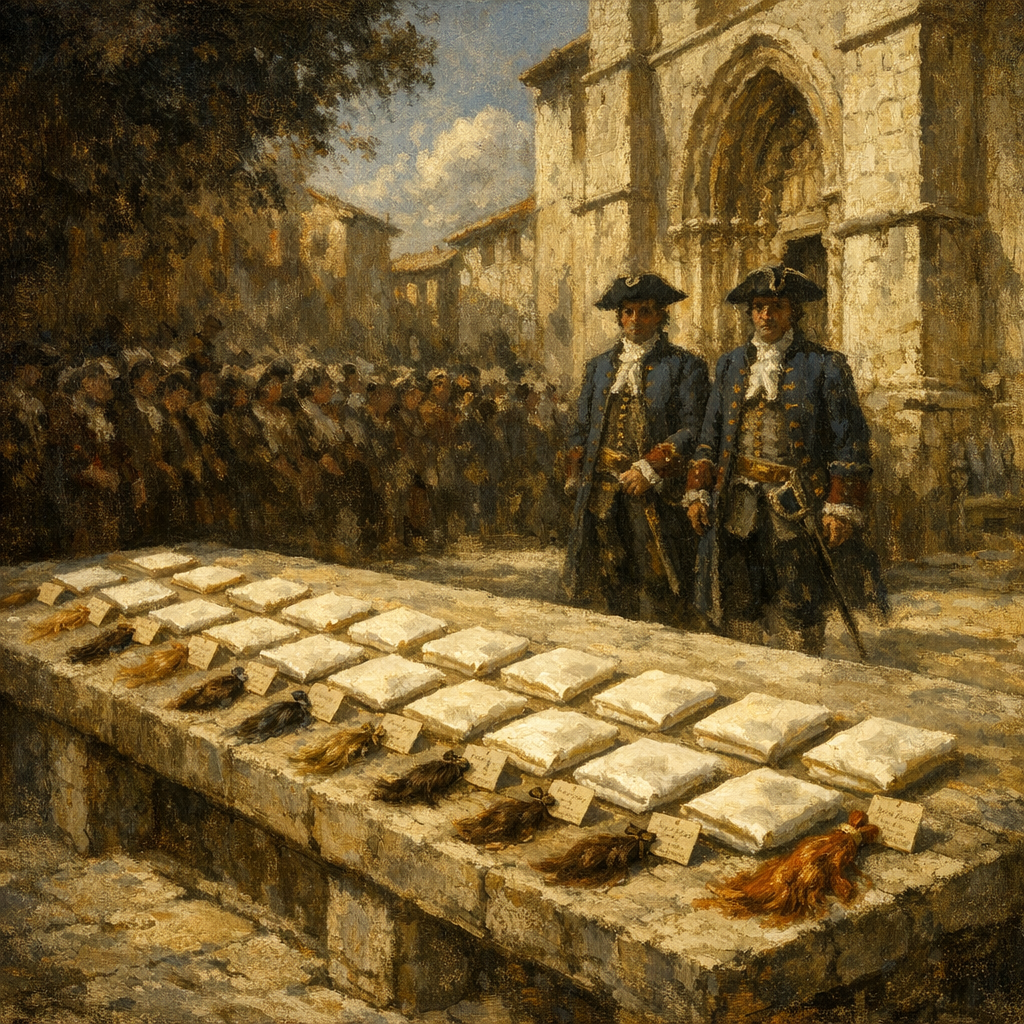
TL;DR: Grenouille's hidden cottage workshop outside Grasse is raided, and twenty-five perfumed cloth squares with their accompanying tied locks of shorn hair — the saved record of every murder of the campaign — are laid out in the church square for the town to see.
Spoilers through Chapter 48.
The town meets, in the form of small folded cloths and tied curls of hair, the actual ledger of what has been done to its daughters.
What happens
The chapter is split between two locations. First, a low shuttered cottage workshop beyond the town gate that Grenouille has been operating out of in secret. Officers find his copper stills, glass vials, racks smeared with rendered fat — and the chest in the corner that holds twenty-five square folded oiled cloths, each with a single tied lock of hair coiled beside it. The cloths still glow faintly to anyone who knows what to look for; to officers who don't, they are just oily linen with hair.
Second, the church square at midday. The bench-platform set up in front of the cathedral. The twenty-five cloths laid out in five neat rows of five. The tied curls — varying from blonde through copper-red to dark — beside each square, with a small printed inventory card pinned to it. Two civic officers stand at attention behind the bench. The townspeople pressed back to the edges of the square, faces a sea of small ovals, fixed on the platform.
Süskind does not narrate the cathedral's bells, the Bishop's response, or the families. He gives us only the bench, the cloths, and the silence.
Key moments
- The cottage search. Stills, vials, fat, the chest of cloths.
- The bench. Twenty-five cloths, twenty-five curls, twenty-five inventory cards.
- The silence of the square. The town confronted with the shape of the loss.
Character shifts
Grenouille is offstage; the chapter belongs to the town. Grasse moves from grief to spectacle — the same square that will, three chapters later, become the scaffold.
Why it matters
The chapter is the book's only sustained image of the full ledger of the campaign. Twenty-five cloths is twenty-five young women — the numbers, by themselves, are an indictment of how long this has been going on under the noses of the town's institutions. Süskind gives us the scale exactly once, in this chapter, and then never lets us see it again.
Themes to notice
- The artist as monster, the monster as artist — the artist's full inventory, finally on public display.
- Pre-Revolutionary France as a body that knows it's rotting — a town discovering, in church-square format, what has been failing inside its own organs.
Book club questions
- Süskind grants the bench-platform the visual register of an altar or a relics-display. Is the prose drawing the religious parallel intentionally?
- The chapter does not name a single victim other than Laure. Is the anonymity respectful, or is it Süskind's own subtle complicity with Grenouille's view of them?
Visual memory hook
A long stone bench at the front of a Grasse church square at noon, twenty-five small folded oiled white linen squares laid out in five rows of five, a single tied lock of hair beside each — varying from blonde through copper-red to dark — and the cathedral's pale stone façade looming behind.
What's next
Chapter 49 reads the sentence.