
Chapter 49
The chapter in one sentence
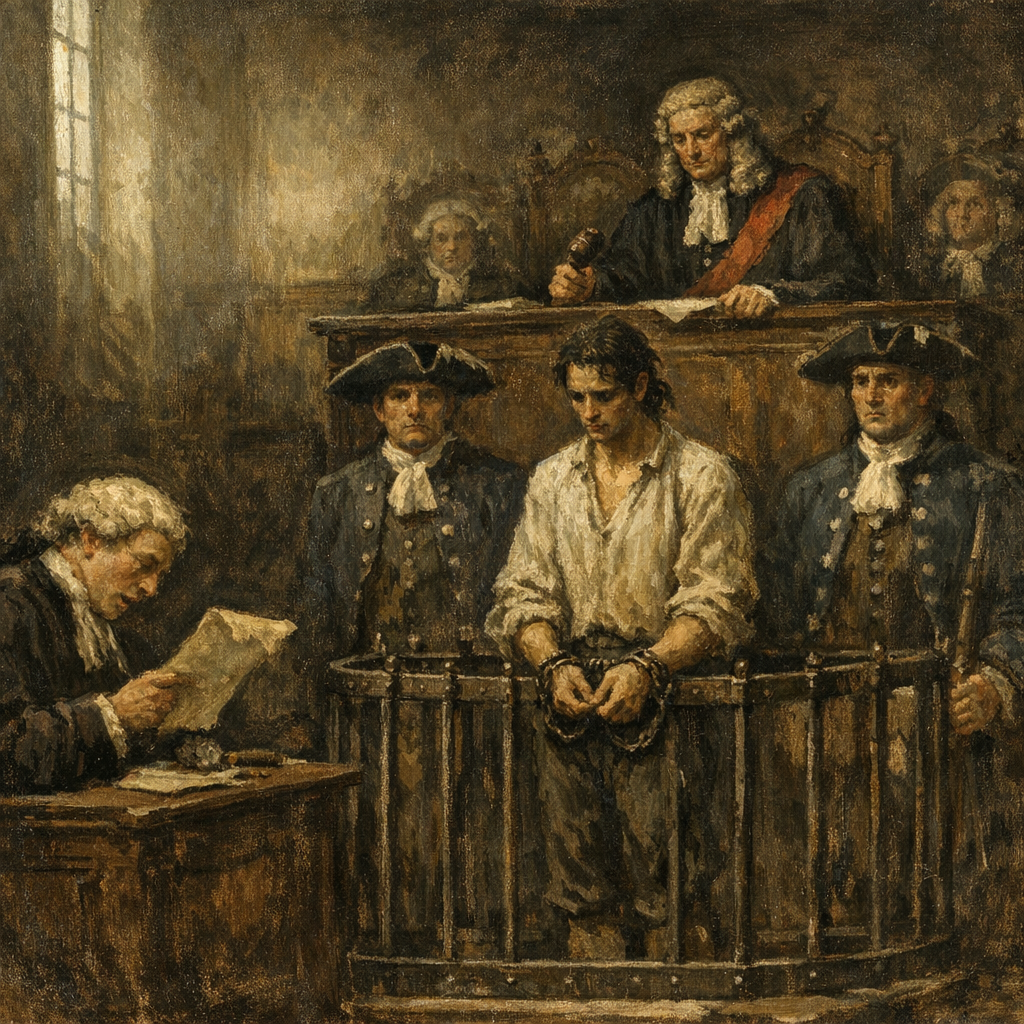
TL;DR: A Grasse tribunal sentences Grenouille to be broken on the wheel and hanged in the Place du Cours, and the town begins immediately to prepare the wooden stage of his public death.
Spoilers through Chapter 49.
The legal apparatus closes over Grenouille and the town, with the same careful efficiency it would apply to any other small-town magisterial matter, sets up the means of execution.
What happens
The Grasse courthouse chamber, day. A high pale-stone room with tall narrow windows admitting hard cool daylight. A heavy walnut presiding-magistrate's bench raised on a low dais. A clerk's smaller desk to the side. A row of wigged judges' chairs behind. A tall iron-banded prisoner's dock at the front, raised one step.
A periwigged court clerk in plain dark robes reads aloud from a parchment sentence-document. The presiding magistrate at the high bench — older, bewigged, in a black-and-red sash of office — gavels his confirmation. Grenouille — slight, dark, hair tied back, in a plain undyed linen prisoner's shirt and dark wool breeches, hands manacled in front, two civic guards in blue coats and tricorns flanking him — stands motionless in the dock, head slightly down, expression entirely empty.
The sentence: to be broken on the wheel and then hanged at the Place du Cours, the main civic square. Town officials begin immediately the standard preparations — scaffold timber, executioner's wheel, four horses for quartering, halberd-bearers for the perimeter.
Key moments
- The reading of the sentence. Bureaucratic, ritualized, swift.
- The empty face. Grenouille's complete absence of reaction. He has been waiting for the sentence since chapter 47.
- The preparations. The cold civic apparatus going into motion.
Character shifts
Grenouille has, in this chapter, been formally finished by the legal system. He is no longer a free man. He is also, by his own measure, no longer a man with anything to do. The work is done. The sentence is just paperwork.
Why it matters
The chapter is the book's last quiet beat before chapter 50 walks Grenouille from his cell and chapter 51 detonates the entire premise. Süskind grants the legal apparatus the dignity of formal procedure — the kind of dignity the next two chapters will reduce to comic improvisation.
Themes to notice
- The artist as monster, the monster as artist — finished, formally, in a courtroom.
- Pre-Revolutionary France as a body that knows it's rotting — its judicial efficiency rendered with full period accuracy, about to be utterly overridden by a single uncorked vial.
Book club questions
- Grenouille's sentence is to be broken on the wheel and hanged. Süskind gives the redundancy without comment. Is the redundancy a measure of the town's grief, the period's brutality, or both?
- The chapter ends without staging Grenouille's reaction. What is Süskind reserving for chapter 50 — and chapter 51?
Visual memory hook
A high pale-stone Grasse courthouse chamber, a small dark hunched figure in a plain undyed linen prisoner's shirt standing motionless between two civic guards in blue coats and tricorns at a tall prisoner's dock, while a periwigged clerk at a side desk reads from a parchment sentence-document.
What's next
Chapter 50 walks him out.