
Chapter 26
Chapter in one sentence
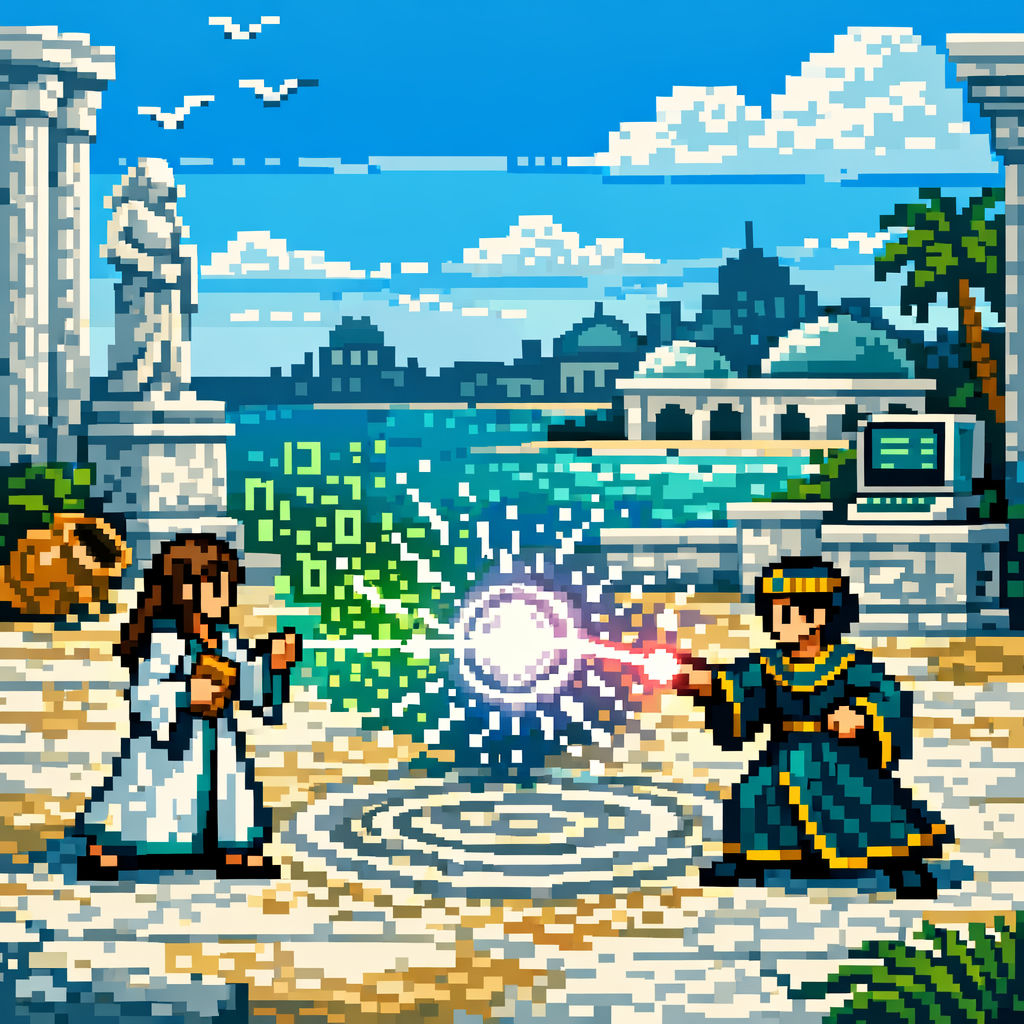
TL;DR: Ida and Gwen face each other in a plaza. The book's first full-register magical duel — two reality-hackers, both controlled, both serious. The other sorceresses intervene before either fights to a finish, but by then the question of who has standing in this city has been answered.
Spoilers through Chapter 26.
The book gives Gwen the climactic confrontation rather than Martin, and the decision reads as a statement.
What happens
A plaza on the marble plateau, late afternoon. Ida, knowing the council will move against her within hours, has chosen to make her stand visibly rather than slip out quietly. She is in her full deep-teal-and-gold robe, gold circlet bright. She is waiting for someone to come.
Gwen comes. She arrives alone (Martin and Phillip are still finishing the post-brawl write-up with the council; the book is precise about this). She has chosen this. She walks across the marble floor in the soft white robe with dark-teal trim that has been her Atlantean look the whole book, and she addresses Ida by her elected title.
The duel that follows is the book's most visually charged action beat. Ida fights in pale-rose pulses and quick scrolling glyphs — political-leader magic, ornate and well-rehearsed. Gwen fights in precise, controlled geometric pulses of pale white light — the same precise non-smoky register as Martin's casting, but in her hands it reads as fluent rather than improvised. The book lets them go for several exchanges before the other sorceresses arrive at speed, surround both combatants, and force the duel down.
By the time Brit the Elder reaches the plaza, Ida is on one knee and Gwen is standing. Neither has been seriously injured. Both have made their point.
Key moments
- Gwen walking into the plaza. The book treats her arrival as ceremonial.
- The first exchange. Ida's pale-rose, Gwen's pale white. The contrast is the gag and the substance simultaneously.
- The sorceresses' arrival. The book is careful to show them as enforcers of the city's safety, not allies of Ida.
- The final tableau. Ida kneeling, Gwen standing, Brit the Elder arriving.
Character shifts
Gwen claims her standing in Atlantis on her own terms. The book has spent twenty-five chapters earning the reader's belief that she can do this; this is the chapter that cashes it. Ida is finished — not destroyed, but finished as a political actor in the city she had been quietly trying to break.
Why it matters
The book's most important non-romance decision is that the climactic duel happens between two women, neither of whom is the protagonist, while the protagonist is finishing paperwork off-screen. The structural choice is the book's clearest statement about whose city this is and whose grievance has standing here.
Themes to notice
- Standing as a thing claimed rather than granted.
- The texture of fluent magic versus rehearsed magic.
- The book's choice of protagonist for its biggest moment.
Book club questions
- The book gives Gwen the duel, not Martin. What is it saying with that choice?
- Ida's magic is ornate; Gwen's is precise. Is the contrast a character beat, a power-level beat, or both?
- The sorceresses intervene before either fights to a finish. Is the book's refusal to deliver a final-blow climax a feature or a structural caution?
Visual memory hook
A marble plaza at golden-hour pixel-light. One figure in deep-teal-and-gold with a gold circlet, kneeling. One figure in white with dark-teal trim, standing. A ring of sorceresses arriving at speed, robes flaring. Pale-rose and pale-white light hanging in the air like the residue of a sentence.
What's next
The post-duel council. Brit the Elder is going to drop the reveal she has been carrying for the whole book — the one that requires Brit the Younger and Phillip to disappear for the loop to close.