
President Ida
Also known as: President
President Ida
TL;DR: The only elected official in the Atlantean triumvirate and the polished political face of the city. Capable, watchful, and not as straightforward as she presents — by the book's climax, the conspiracy behind the attempts on Brit the Younger traces back through her inner circle to her.
Spoiler level: full book. This page assumes you've finished Spell or High Water.
Snapshot
A politician who is exceptionally good at the visible job and quietly running a different one in private. Ida is composed, attentive, and reads every room before she enters it. The book takes its time establishing her as competent before slowly pulling the thread that reveals what she's actually been doing — which makes the climactic confrontation hit harder than a simple-villain reveal would.
Role in the story
Ida is the third member of the triumvirate alongside Brit the Elder and Brit the Younger. As the only elected member, she handles the diplomatic face of Atlantean governance — receiving visiting time-traveler delegations, presiding over the summit, managing the city's protocols. She is present in most of the formal-Atlantis chapters as the agreeable, capable host.
Her arc is a slow-burn antagonism. The early chapters give the reader no reason to suspect her. The middle chapters drop quiet hints that something about her response to the "accidents" doesn't quite add up. The investigation chapters trace the chain of evidence through her household, including her man-servant Neeloh. By the climax, Ida and Gwen face each other directly in a magical duel — Gwen, not Brit the Younger or Brit the Elder, because the book is making a point about whose city is whose. The other sorceresses intervene before either fights to a finish, and Ida is removed from the triumvirate in the post-climax council reshuffle.
Personality in plain English
Composed and watchful. Ida is the kind of leader who never raises her voice and never quite shows what she's thinking. She is gracious in private and on stage. She is funny in a measured, hostess register — small jokes timed to defuse small tensions. The book is careful not to make her cartoonishly two-faced; her warmth in the early chapters is real enough to read as warmth, even after the reveal.
What separates Ida from a more standard political villain is that she has a grievance. The book sketches it carefully and doesn't fully resolve it: Ida has been working within constraints she didn't choose, in a city she didn't design, where her elected status is treated as decorative by two co-rulers who are technically the same eternal person. By the end, the reader is invited to feel her motive even while rejecting her methods.
What she wants
A meaningful share of actual power in a city where her two co-rulers are literally each other. The disruption of a stable time loop she had no part in designing. To matter, in a setting where the future is already decided.
What she fears
Being the elected official who is only there for show. Being remembered as the one who tried to break the city and got caught. The two Brits' loop closing successfully — because if it does, her window for changing the city's future closes with it.
Key relationships
- Brit the Elder. Co-ruler and, until the reveal, a working political partner. The Elder is not surprised by the betrayal in the way the reader is; the book hints she had suspected for longer than she said.
- Brit the Younger. Co-ruler in name, target of the conspiracy in fact. Ida's polished friendliness toward her in the early chapters lands very differently after the reveal.
- Neeloh. Her man-servant and the physical agent of the assassination attempts. The book is careful to show Neeloh as her instrument rather than her equal — Ida is the planner, he is the hand.
- Gwen. Eventual antagonist. The duel between them is one of the book's most visually charged set-pieces.
- Martin and Phillip. Diplomatic counterparts through most of the book; opponents in the third act.
Visual identity
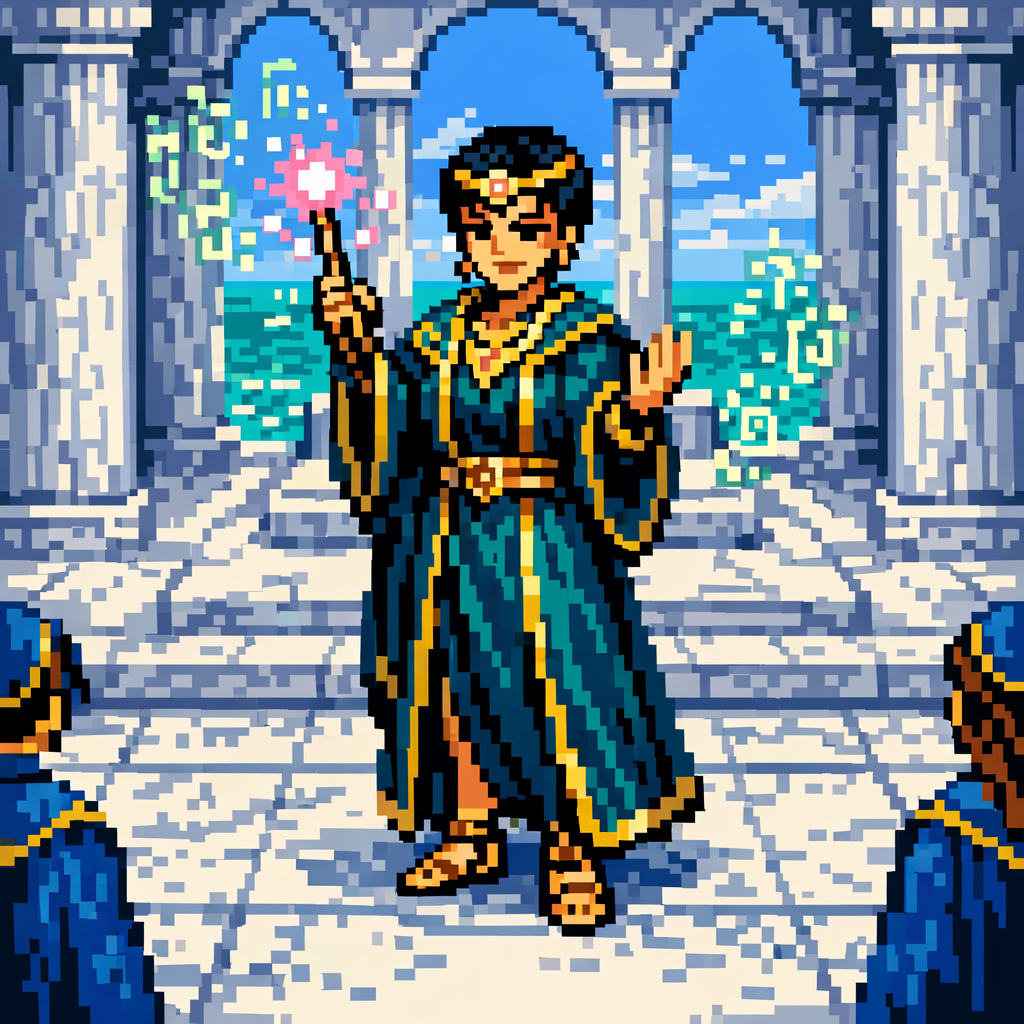
Adult woman, age-frozen like all magic users — reads as mid-30s apparent age, confident leader-energy. Short dark hair pixels in a tight, neat cut, distinguishing her sharply from the long-haired Brits. Sharp, watchful face with a slight political smile that doesn't reach the eyes. She wears a long deep-teal Atlantean robe with gold trim — more saturated and ornate than the Brits' white-and-teal robes, signaling her elected-political-leader status. A gold or bronze circlet sits across her forehead with a small carved pixel-block sigil at center. In ceremonial scenes she carries a scroll bound with a gold ribbon or a small wand-like rod with a single pale-rose glowing pixel at the tip. In the climactic duel her magic reads as pale-rose pulses and quick scrolling glyphs.
Aliases
The following names and references in the book all point to this character. Use any of these as link anchors back to this page.
- President Ida (canonical — the most common form)
- Ida
Discussion questions
- The book gives Ida a grievance the reader is invited to sympathize with. Where is the line between understanding her motive and endorsing it?
- Ida is the only elected leader of Atlantis, and she is the one who tries to break the city. Is the book making a point about elected versus inherited authority, or is that a coincidence of plot?
- Neeloh is Ida's man-servant. The conspiracy runs through her household. What does the book think about the politics of using your own staff as your instrument?
- Gwen, not one of the Brits, fights Ida at the climax. What is the book saying with that choice?
- Ida is removed from the triumvirate at the end. Is the council's response to her conspiracy proportionate, harsh, or lenient?